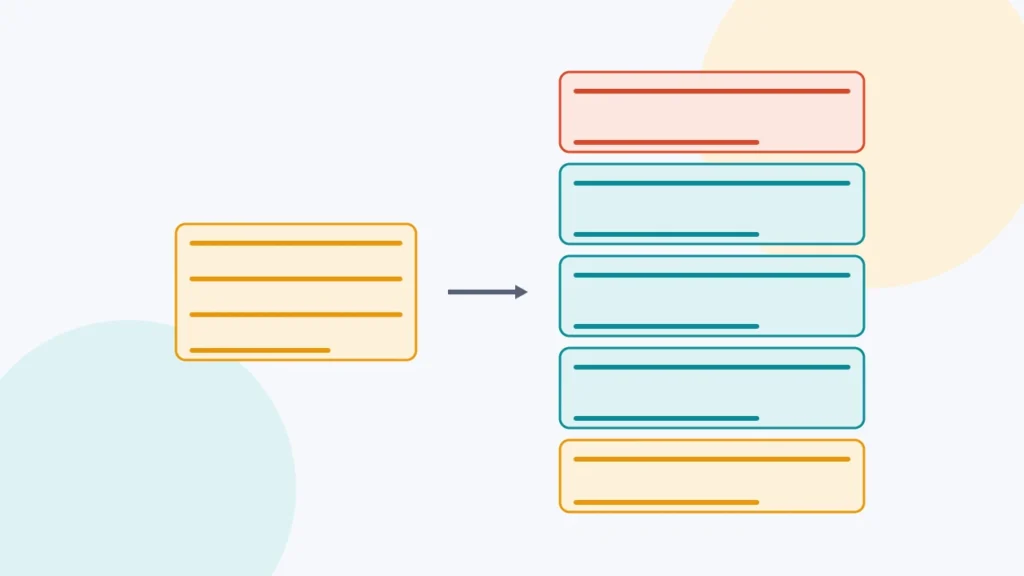
The main difference between an essay and a paragraph is scope. A paragraph is a group of related sentences that develops one main idea. An essay is a longer piece of writing made of several paragraphs that together develop one central argument or topic, called the thesis. Put simply, paragraphs are the building blocks, and an essay is the building.
This guide compares the two side by side, shows the same topic written as a paragraph and as an essay outline, and explains how to tell which one your teacher or exam question is asking for.
Key takeaways
- A paragraph = one main idea. An essay = one thesis developed through several main ideas.
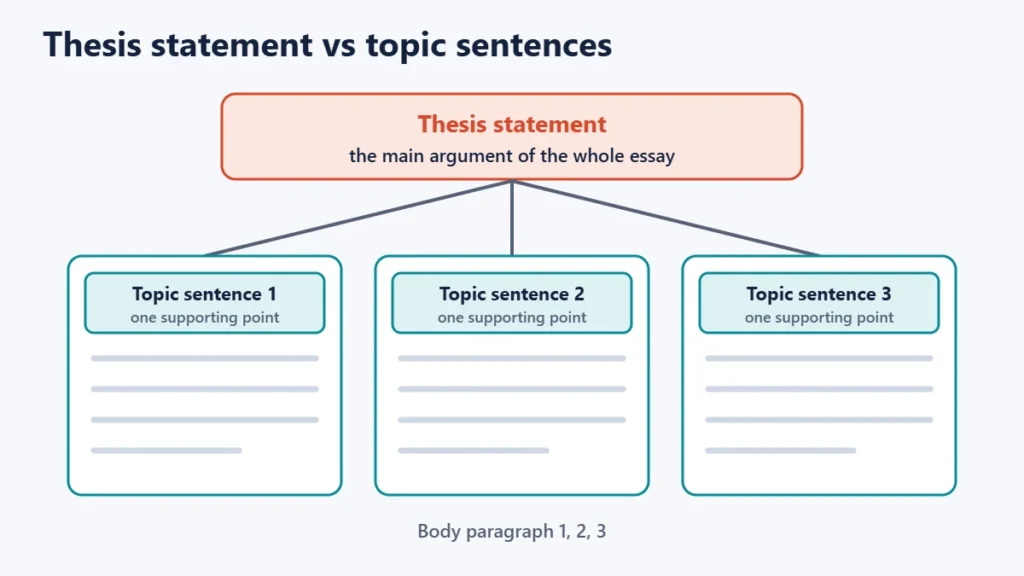
- A paragraph has a topic sentence; an essay has a thesis statement.
- A paragraph is usually 4 to 7 sentences in school writing; a short school essay is often 5 paragraphs.
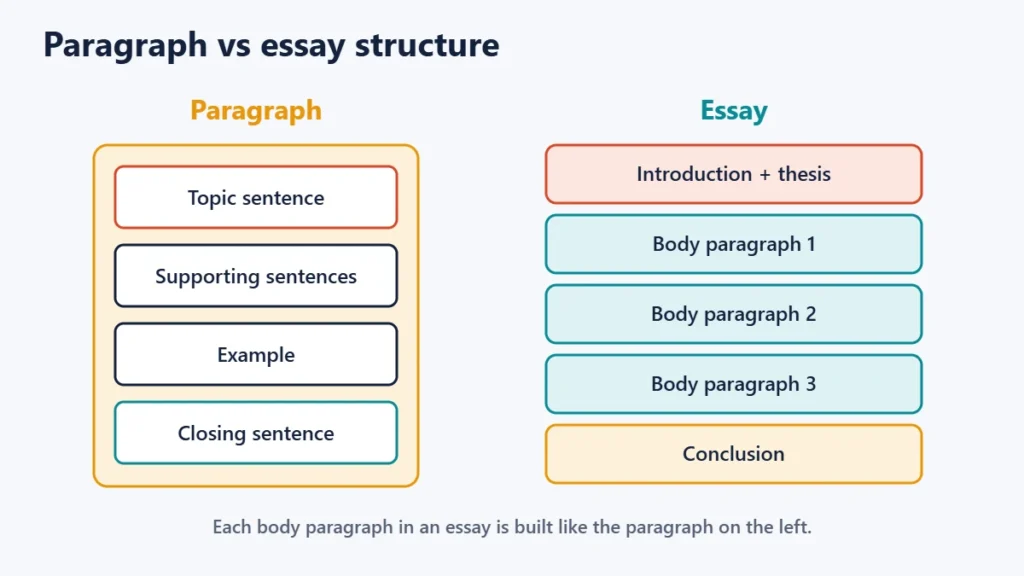
- An essay has an introduction, body paragraphs and a conclusion. A paragraph has a topic sentence, support and a closing sentence.
- The skills overlap: a good essay depends on good paragraphs.
Essay vs paragraph: comparison table
| Feature | Paragraph | Essay |
|---|---|---|
| Definition | A group of related sentences about one main idea | A piece of writing made of several paragraphs on one topic or argument |
| Scope | Narrow: one point | Wide: a full topic, explored from several angles |
| Main idea stated in | The topic sentence | The thesis statement |
| Structure | Topic sentence, supporting sentences, closing sentence | Introduction, body paragraphs, conclusion |
| Typical school length | About 4 to 7 sentences (roughly 80 to 150 words) | Often 300 to 1,000 words, depending on the class and task |
| Number of paragraphs | One | Usually three or more; five is common for short essays |
| Introduction and conclusion | An opening and closing sentence only | Full paragraphs for each |
| Common uses | Short answers, paragraph-writing questions, parts of letters and reports | Essay questions, assignments, competitions, exam long answers |
The lengths above are typical for school writing, not fixed rules. Always follow the word limit in your question or assignment.
What is a paragraph?
A paragraph is the smallest complete unit of an argument or explanation. Purdue University’s Online Writing Lab describes it as a collection of related sentences dealing with a single topic. A good paragraph has:
- a topic sentence that states the main idea,
- supporting sentences that explain it and give an example,
- a closing sentence that wraps up the idea or leads to the next one.
Our step-by-step guide on how to write a paragraph covers this in detail.
What is an essay?
An essay explores a topic more fully. It starts with an introduction that ends in a thesis statement, the one or two sentences that state your main argument. Each body paragraph then develops one supporting point, and the conclusion pulls everything together. See our guide on how to write an essay for the full method.
Same topic, two forms: an example
Here is one topic written two ways. Both examples were written by The Study Cafe team as learning material.
As a paragraph
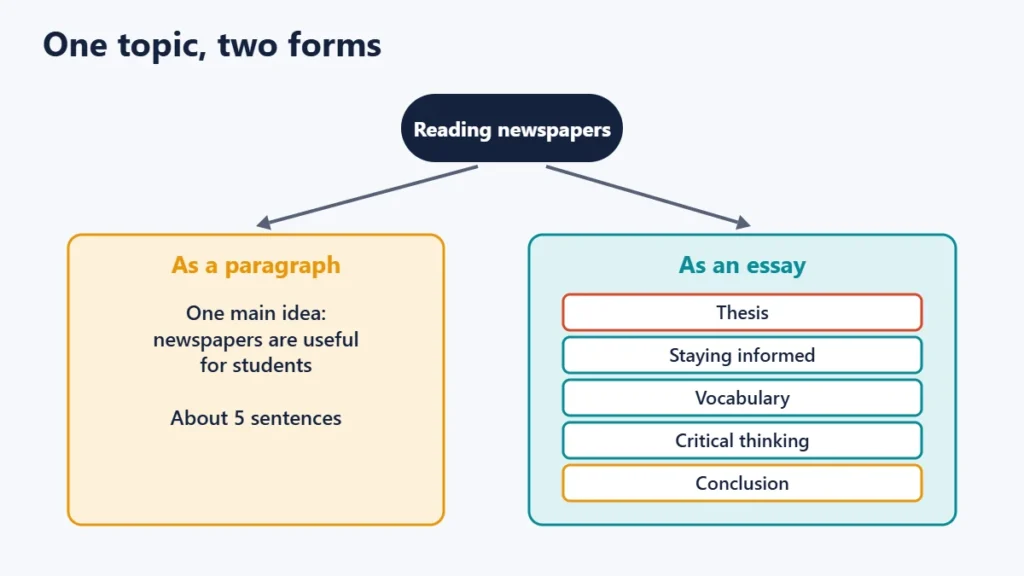
Reading newspapers is a useful habit for students. A daily newspaper keeps readers informed about events in their city, their country and the wider world. For example, a student who reads about a new science discovery may find their science lessons more interesting. Newspapers also introduce new words in a real context, which helps vocabulary grow. For these reasons, even ten minutes of newspaper reading a day can make a real difference.
One idea (newspapers are useful), supported by a couple of examples, in five sentences.
As an essay (outline)
- Introduction: hook about how much news students see on phones; thesis: “Reading newspapers regularly helps students stay informed, improve their language and think critically.”
- Body paragraph 1: staying informed about local, national and world events.
- Body paragraph 2: improving vocabulary and writing style.
- Body paragraph 3: learning to compare views and think critically about what they read.
- Conclusion: restate the thesis in new words and suggest starting with ten minutes a day.
Notice that each of the three main points could become a full paragraph like the one above. That is exactly how essays are built. You can see a finished essay on a similar topic in our essay on reading the newspaper.
Topic sentence vs thesis statement
| Topic sentence | Thesis statement | |
|---|---|---|
| Belongs to | One paragraph | The whole essay |
| Where it goes | Usually the first sentence of the paragraph | Usually the last sentence of the introduction |
| What it does | States one point | States the main argument that all body paragraphs support |
| Example | “Newspapers help students build vocabulary.” | “Reading newspapers helps students stay informed, improve their language and think critically.” |
How to tell which one the question wants
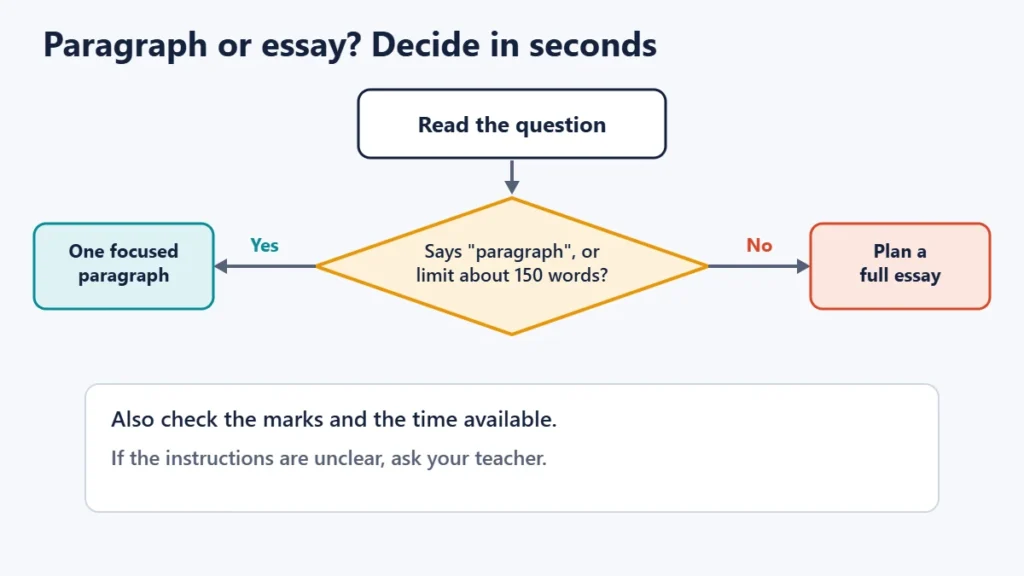
- Look for the word itself. “Write a paragraph on…” or “Write a short note on…” usually means one paragraph. “Write an essay on…” means several.
- Check the word limit. Around 100 to 150 words usually means a paragraph. 250 words or more usually means an essay.
- Check the marks. In many school exams, short-answer and paragraph questions carry fewer marks than essay questions, so they deserve less time. Follow your own board’s or teacher’s marking scheme.
- When unsure, ask. Your teacher’s instructions always come first.
Common mistakes
- Writing an essay when a paragraph was asked. Going far over the word limit can lose marks and wastes exam time.
- Writing one long paragraph for an essay question. Without separate paragraphs, the reader cannot see your structure.
- Mixing several ideas in one paragraph. Each paragraph, whether alone or inside an essay, should have one main idea.
- Forgetting the thesis. An essay without a clear thesis is just a collection of paragraphs.
Frequently asked questions
How many paragraphs make an essay?
There is no fixed number, but short school essays commonly have five: an introduction, three body paragraphs and a conclusion. Longer essays have more body paragraphs.
Can a single paragraph be an essay?
Not usually. An essay needs an introduction, body and conclusion, so it is made of several paragraphs. A single paragraph is sometimes called a paragraph answer or a short composition.
Is a paragraph shorter than an essay?
Yes. A paragraph is one part of an essay, so an essay is always longer than any one of its paragraphs.
What comes first, learning paragraphs or essays?
Paragraphs. Once you can write a clear, well-supported paragraph, writing an essay is mostly a matter of planning several paragraphs around a thesis.
How should I end an essay compared with a paragraph?
A paragraph ends with one closing sentence. An essay ends with a full concluding paragraph. Our guide on how to end an essay shows several ways to do it.
Summary
A paragraph develops one idea in a handful of sentences. An essay develops one thesis across several paragraphs, with an introduction and a conclusion. Learn to write strong paragraphs first, then combine them into essays, and always check the question and word limit to see which form you need.