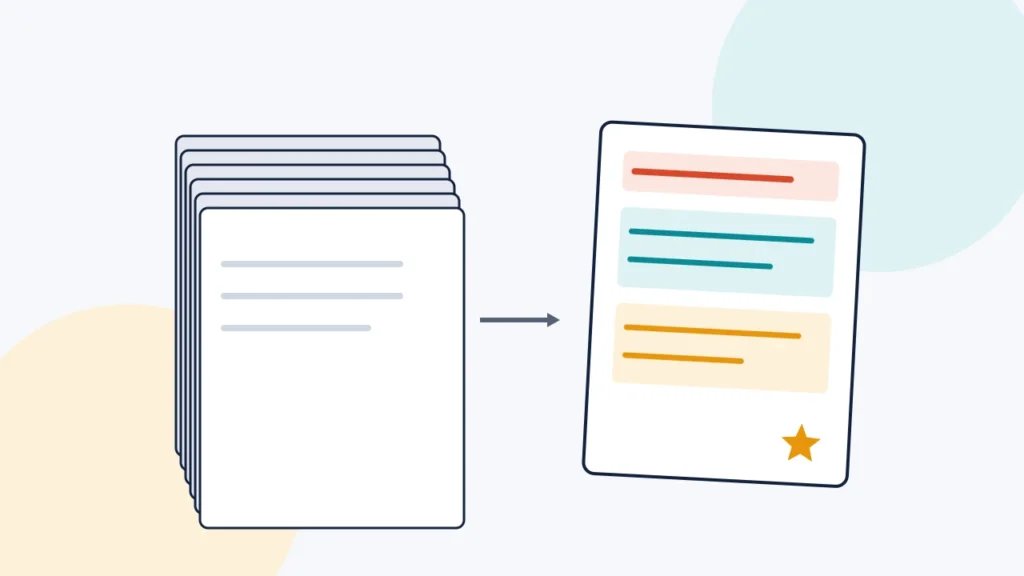
To make short notes for revision, finish studying a chapter first, then go through it section by section and write only the key ideas, definitions, formulas and diagrams in your own words, using bullets, tables and keywords instead of full paragraphs. Good short notes fit a whole chapter into one or two pages and can be revised in about 10 to 15 minutes.
This guide covers when to make short notes, a step-by-step method, formats that work for different subjects, a worked example, how to use the notes to revise, and the mistakes that make notes too long to be useful.
Key takeaways
- Make short notes after you have studied a chapter once, not during your first reading.
- Write in your own words; copying the textbook is not note-making.
- Keep only what you need to revise: key terms, definitions, formulas, steps, dates, diagrams and common mistakes.
- Use compact formats: bullets, tables, flowcharts and labelled sketches.
- Use the notes to test yourself, not just to reread.
What are short notes, and why make them?
Short notes, sometimes called revision notes, are a condensed version of a chapter that you can review quickly before a test or exam. They are different from class notes, which record a lesson as it happens, and from a written summary, which is a short piece of connected prose.
| Class notes | Short notes | Chapter summary | |
|---|---|---|---|
| When | During the lesson | After studying the chapter | After reading the chapter |
| Length | Several pages | About 1 to 2 pages per chapter | A paragraph or two |
| Format | Whatever you can write fast | Bullets, tables, diagrams, keywords | Full sentences |
| Main use | Learning the topic | Fast revision and self-testing | Understanding the big picture |
Making short notes is also a learning activity in itself: deciding what is important and putting it in your own words forces you to understand the chapter. For a prose version, see our guide on how to write a summary of a chapter.
When to make short notes
- After you have studied the chapter once. On a first reading you do not yet know what matters, so notes tend to become a copy of the book.
- Before the exam season starts. Making notes chapter by chapter during the term means you only need to revise them later, not create them in a rush.
- After a practice test. Add the mistakes you made to the notes so you do not repeat them.
How to make short notes: step by step
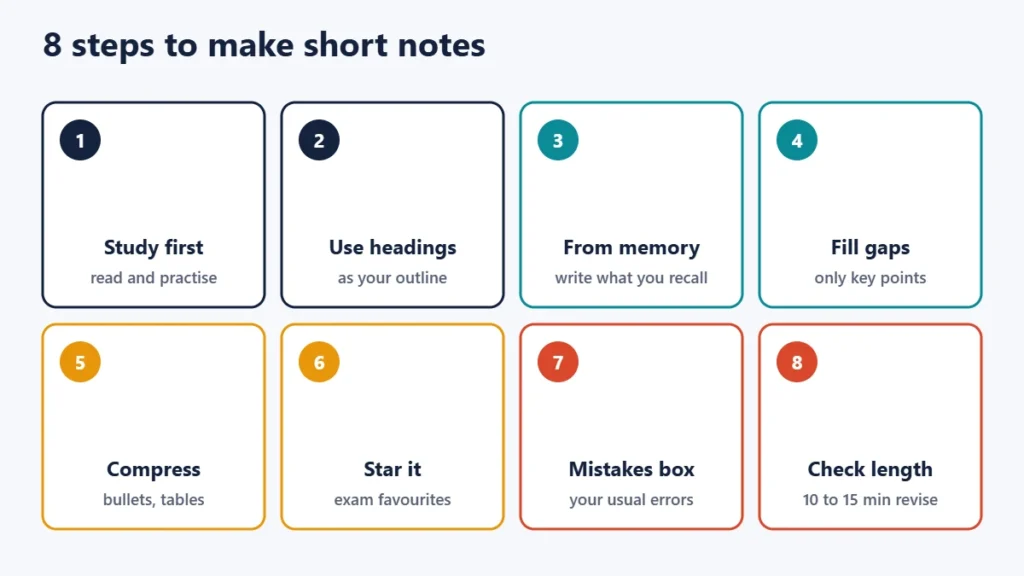
- Study the chapter first. Read it, attend the lesson and try the textbook questions.
- Use the headings as your outline. Write each section heading as a short title on your notes page.
- Close the book and write what you remember under each heading in a few keywords or bullets.
- Open the book and fill the gaps. Add only what is important: definitions, formulas, key steps, names, dates, diagrams.
- Compress. Turn sentences into keywords, lists into tables, processes into flowcharts.
- Mark exam-relevant points. Star topics your teacher stressed or that appear often in past papers.
- Add a “mistakes” box listing errors you tend to make on this chapter.
- Check the length. If you cannot revise the whole page in about 10 to 15 minutes, cut it down further.
Step 3 is a quick form of active recall. Writing from memory before checking makes the notes stronger and shows you what you have not yet learned. Read more in our guide to the blurting method.
Formats that keep notes short
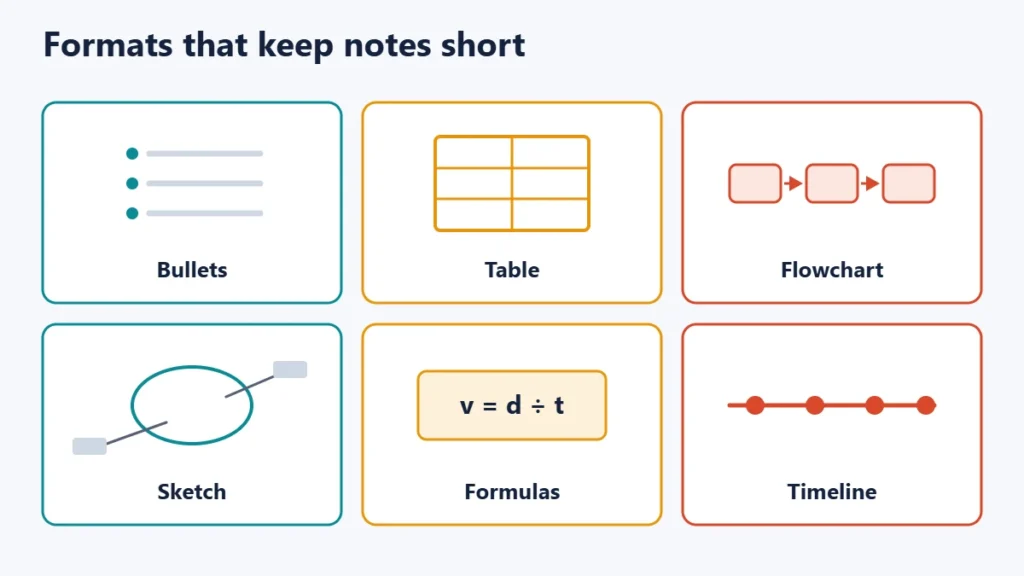
| Format | Best for | Example |
|---|---|---|
| Bullet points | Lists of features, causes, uses | Properties of metals |
| Comparison table | Two or more similar things | Mitosis vs meiosis |
| Flowchart | Processes and sequences | Stages of the water cycle |
| Labelled sketch | Structures and parts | Parts of a flower |
| Formula box | Maths and physics | Speed = distance ÷ time |
| Timeline | History events | Key events of a freedom movement |
| Mind map | Seeing how ideas connect | Causes and effects of pollution |
| Question and answer | Self-testing | “What is osmosis?” |
Worked example: short notes for a science chapter
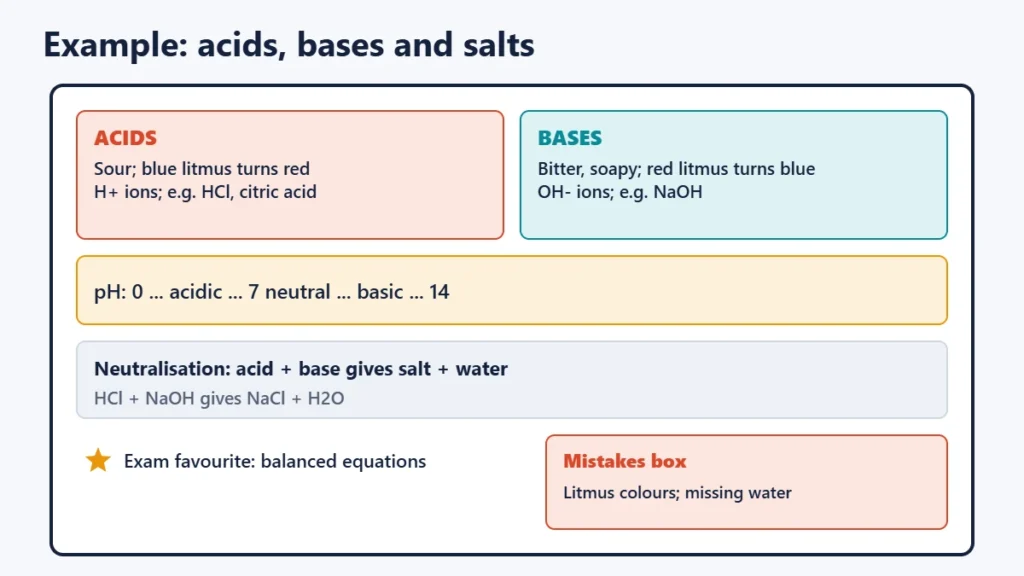
Here is an illustrative short-notes page written by The Study Cafe team for a chapter on acids, bases and salts.
ACIDS, BASES AND SALTS            (Class 10 Science)

ACIDS: sour, turn blue litmus RED, release H+ ions in water
  e.g. HCl, H2SO4, citric acid (lemons)
BASES: bitter, soapy, turn red litmus BLUE, OH- ions
  e.g. NaOH, Ca(OH)2, baking soda solution
pH scale: 0-14 | <7 acidic | 7 neutral | >7 basic
NEUTRALISATION: acid + base -> salt + water
  HCl + NaOH -> NaCl + H2O
Acid + metal -> salt + hydrogen gas (pops with lit splint)

* Exam favourite: write balanced equations
MISTAKES: mixing up litmus colours; forgetting water
          in neutralisation equations
The whole chapter fits in a few lines, with an example for each idea, one equation, a starred exam point and a mistakes box.
Subject tips
- Maths: list formulas and one short worked example per question type. Note the common traps.
- Physics and chemistry: formulas with units, key definitions, important reactions and one diagram per concept.
- Biology: labelled diagrams, process flowcharts and comparison tables of similar terms.
- History and political science: timelines, causes and consequences, and key people.
- Geography: map sketches, definitions and tables comparing regions or features.
- English literature: characters, themes, key quotations and techniques for each text.
How to revise from your short notes
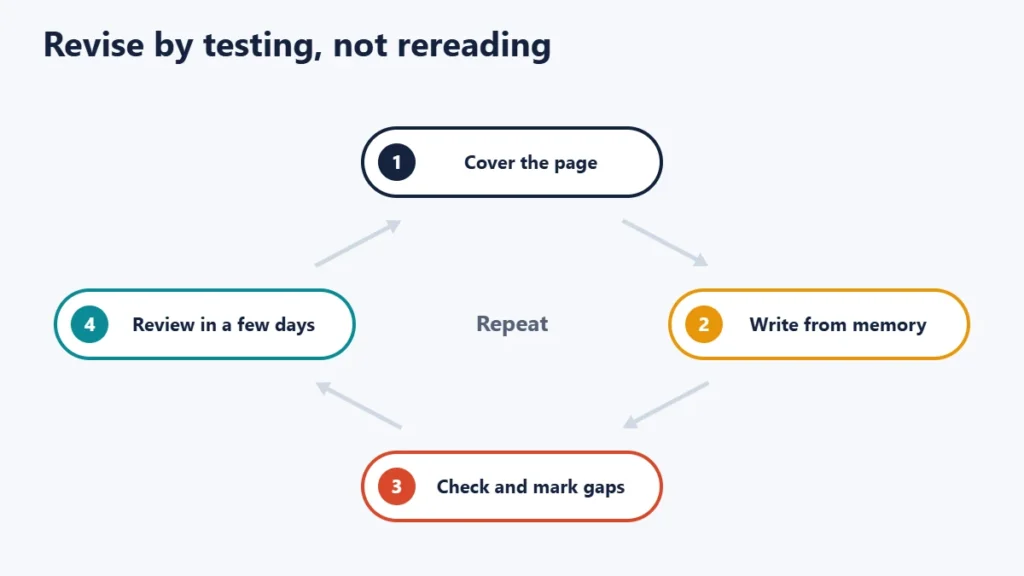
Short notes are most useful when you test yourself with them:
- Cover the page and write down everything you remember about the chapter.
- Uncover it and check. Mark what you missed.
- Turn key points into questions and quiz yourself or a friend.
- Review the notes again after a few days, and again closer to the exam.
If you take notes during class using the Cornell note-taking method, the summary and cue questions on each page give you a head start on your short notes. A spaced plan such as the 2357 method tells you when to review them.
Common mistakes
- Copying the textbook. If your notes are nearly as long as the chapter, they are not short notes.
- Making notes on the first reading. You end up writing everything because you do not yet know what matters.
- Too much decoration. Colour helps, but hours spent on lettering are hours not spent practising.
- No examples. One quick example per idea makes the note much easier to recall.
- Never using them. Notes only help if you revise and test from them regularly.
- Loose sheets everywhere. Keep notes in one notebook or folder per subject, in chapter order.
Frequently asked questions
How long should short notes be?
Roughly one to two pages per chapter is a useful target. If you cannot revise a chapter’s notes in about 10 to 15 minutes, they are probably too long.
Should I make short notes by hand or digitally?
Either works. Handwriting makes diagrams and quick sketches easy; digital notes are easy to edit and search. Choose the one you will actually use.
Are short notes enough to revise for an exam?
They are an excellent revision tool, but combine them with practice questions and past papers, especially in maths and science.
Can I use someone else’s short notes?
They can help as a check, but making your own is part of the learning. Deciding what to include is what helps you understand and remember the chapter.
When is the best time to make short notes?
Soon after you finish studying each chapter, ideally during the term, so that before exams you only need to revise them.
Final word
Good short notes turn a long chapter into one or two pages you can revise in minutes. Study first, then write from memory, fill gaps, compress into bullets, tables and diagrams, and add your common mistakes. Most importantly, use the notes to test yourself regularly, and they will become one of your most valuable revision tools.