
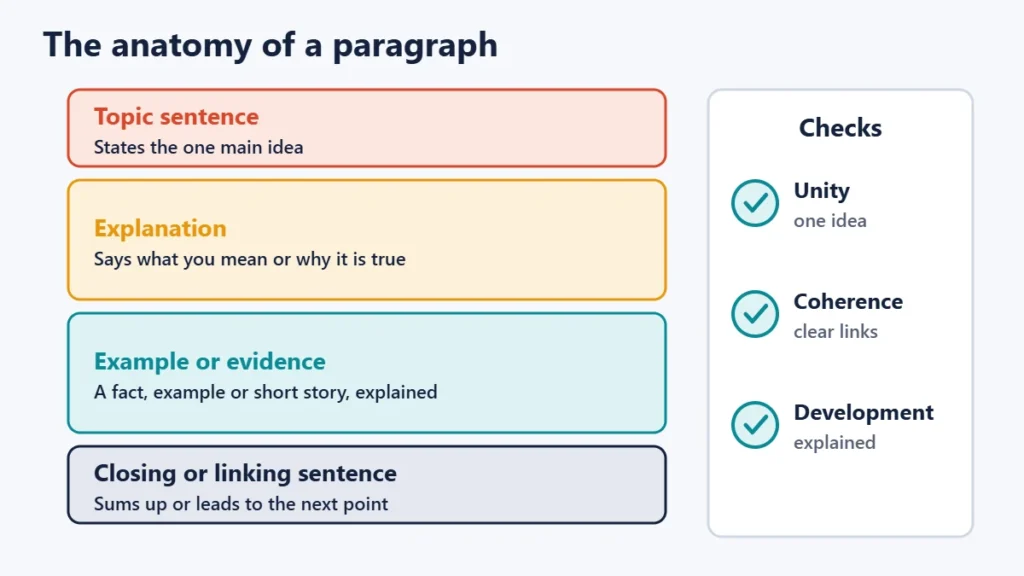
To write a good paragraph, start with a topic sentence that states one main idea, add sentences that explain and support it with an example, and finish with a sentence that wraps up the idea or leads to the next one. Every sentence in the paragraph should be about that single idea. A paragraph is not defined by how many lines it has; it is defined by staying on one point and developing it fully.
This guide explains the parts of a paragraph, gives a five-step method with a worked example, shows how to fix weak paragraphs, and ends with an original practice exercise and answers to common questions.
Key takeaways
- A paragraph is a group of related sentences about one main idea.
- Good paragraphs have unity (one idea), coherence (clear links between sentences) and enough development (explanation and examples).
- The topic sentence usually comes first and tells the reader what the paragraph is about.
- Start a new paragraph when you move to a new idea, contrast ideas, or begin your introduction or conclusion.
- Two or three short sentences are usually not enough to develop an idea properly.
What is a paragraph?
Purdue University’s Online Writing Lab defines a paragraph as “a collection of related sentences dealing with a single topic.” The Writing Center at the University of North Carolina at Chapel Hill makes a similar point: what makes a group of sentences a paragraph is not its length but the unity and coherence of its ideas.
In school writing, paragraphs appear everywhere: in essays, answers to long questions, letters, reports and stories. Learning to write one well is the foundation for all of them.
The four qualities of a good paragraph
Purdue OWL lists four elements that make a paragraph work:
| Quality | What it means | Quick test |
|---|---|---|
| Unity | The whole paragraph sticks to one main idea | Does every sentence relate to the topic sentence? |
| Coherence | Sentences follow a logical order and connect smoothly | Can a reader follow it without getting lost? |
| Topic sentence | A sentence that states the main idea | Can you point to the sentence that says what this paragraph is about? |
| Adequate development | The idea is explained and supported, not just mentioned | Is there at least one explanation and one example? |
How to write a paragraph in five steps
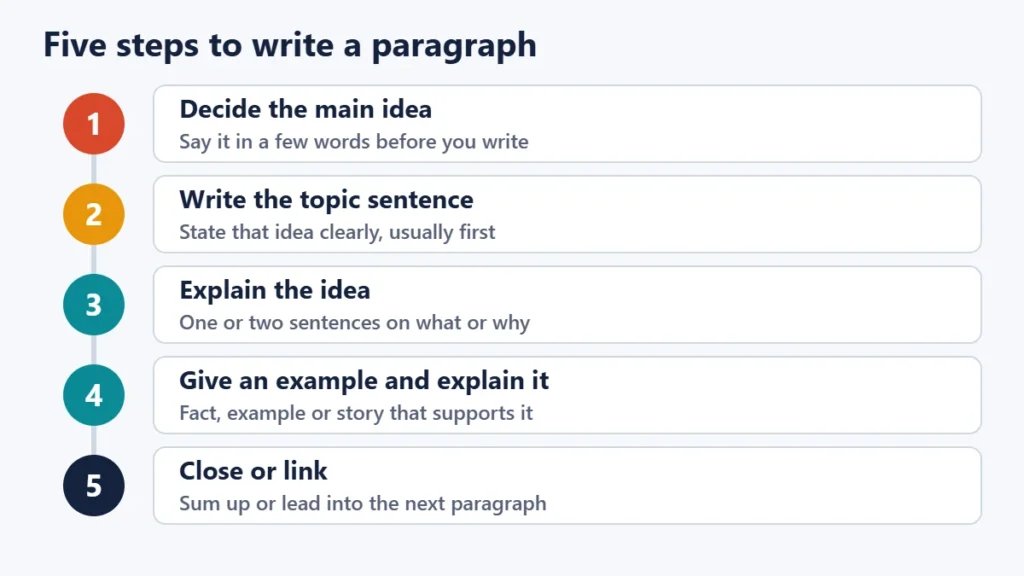
The UNC Writing Center suggests a similar sequence for developing a paragraph. Here it is as five simple steps:
- Decide the main idea. Before writing, say in a few words what this paragraph is about. If you cannot, you are not ready to write it yet.
- Write the topic sentence. State the main idea clearly in one sentence, usually at the start. “Trees are essential for keeping cities cool” is clearer than “Trees are important.”
- Explain the idea. Add one or two sentences that tell the reader what you mean or why it is true.
- Give an example and explain it. Add a fact, an example, a quotation or a short story that supports your point, then say how it supports the point. For a longer paragraph, you can repeat this step with a second example.
- Close or link. End with a sentence that sums up the point or connects it to your next paragraph or your essay’s main argument.
Worked example: building a paragraph step by step
Here is how the steps come together for the topic “Why students should have a hobby”. This illustrative example was written by The Study Cafe team.
- Main idea: hobbies help students manage stress.
- Topic sentence: A hobby gives students a healthy way to manage the stress of school life.
- Explanation: When the mind is busy with something enjoyable, it gets a break from worrying about tests and homework.
- Example and explanation: For instance, a student who spends half an hour painting or playing football in the evening often returns to studying feeling calmer and more focused. The activity works like a reset button for the mind.
- Closing sentence: For this reason, a hobby is not a waste of study time but a way to make that time more productive.
The finished paragraph:
A hobby gives students a healthy way to manage the stress of school life. When the mind is busy with something enjoyable, it gets a break from worrying about tests and homework. For instance, a student who spends half an hour painting or playing football in the evening often returns to studying feeling calmer and more focused. The activity works like a reset button for the mind. For this reason, a hobby is not a waste of study time but a way to make that time more productive.
Notice that every sentence is about hobbies and stress. Nothing wanders off into, say, the cost of art supplies.
Transition words that improve coherence
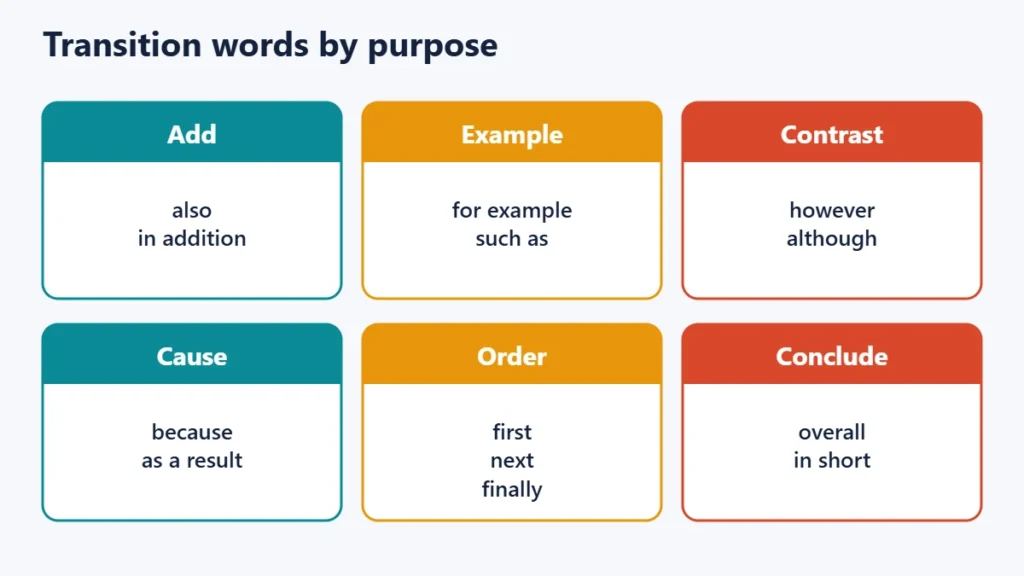
Purdue OWL describes coherence as being built with logical and verbal “bridges”. Transition words are the simplest bridges. Use them to show how one sentence relates to the next:
| Purpose | Transition words |
|---|---|
| Adding a point | also, in addition, moreover, furthermore |
| Giving an example | for example, for instance, such as |
| Showing contrast | however, on the other hand, but, although |
| Showing cause and effect | because, as a result, therefore, so |
| Showing order | first, next, then, finally |
| Concluding | in short, overall, for this reason |
Do not overuse them. One or two per paragraph, in the right places, is usually enough.
When should you start a new paragraph?
Purdue OWL gives four common reasons to begin a new paragraph:
- When you begin a new idea or point.
- When you want to contrast information or ideas.
- When readers need a pause, for example because the paragraph is getting too long or the material is complex.
- When you are ending your introduction or starting your conclusion.
The basic rule is simple: one idea, one paragraph. In a typical school essay, each body paragraph covers one of your main points, as explained in our guide on how to write an essay.
How long should a paragraph be?
There is no fixed number of sentences. Purdue OWL warns that a paragraph of only two or three sentences is probably not fully developed, while one that runs most of a page may need splitting so the reader can take a pause. For most school assignments, a body paragraph of about four to seven sentences is a sensible target: enough for a topic sentence, an explanation, an example and a closing line. Follow any word limits your teacher gives.
Fixing a weak paragraph
Compare these two versions of a paragraph on reading.
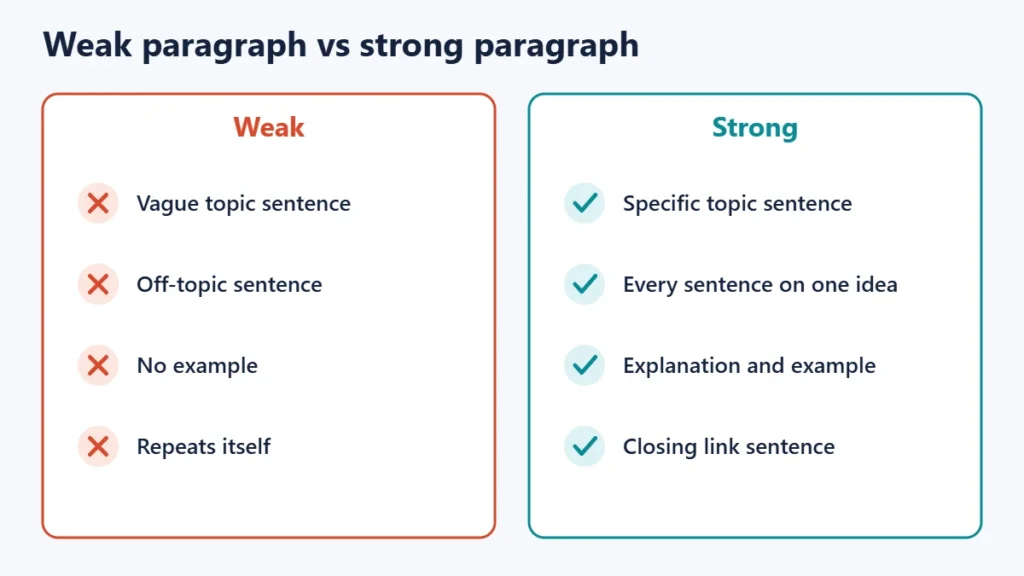
Weak: Reading is good. Many people read books. Libraries have lots of books, and some are very old. Reading is good for students and everyone should read.
Improved: Reading regularly helps students build a stronger vocabulary. Each time a reader meets an unfamiliar word in a sentence, the surrounding words give clues to its meaning. For example, a student who reads “the exhausted runner collapsed at the finish line” can work out that “exhausted” means very tired. Over time, these small discoveries add up, which is why regular readers often find it easier to express themselves in their own writing.
What changed:
- The vague topic sentence (“Reading is good”) became a specific one about vocabulary.
- The off-topic sentence about old library books was removed (unity).
- An explanation and a concrete example were added (development).
- “For example” and “which is why” link the sentences (coherence).
Common paragraph mistakes
- No clear topic sentence. The reader has to guess what the paragraph is about.
- Two or more main ideas. Split them into separate paragraphs.
- Only claims, no support. Every main point needs at least one explanation or example.
- Repeating the same point in different words. This adds length but not development.
- Ending abruptly. A closing or linking sentence helps the reader see why the point matters.
- One giant block of text. If a paragraph covers several steps or ideas, break it up.
Practice exercise (original)
Try these on paper, then compare with the suggested answers below.
- Which sentence does not belong? “Mobile phones help students learn. They can look up facts in seconds. Educational apps explain difficult topics with videos. My cousin bought a new phone last week.”
- Rewrite this weak topic sentence to be more specific: “Exercise is good.”
- Write a full paragraph of five sentences on the topic “Why we should save water”, using the five steps above.
Suggested answers: (1) “My cousin bought a new phone last week” breaks unity, because it is not about learning. (2) One possible answer: “Regular exercise helps students concentrate better in class.” (3) Answers will vary; check that yours has a topic sentence, an explanation, an example and a closing sentence.
Frequently asked questions
How many sentences are in a paragraph?
There is no fixed rule. For school essays, four to seven sentences is a common range. Purdue OWL notes that two or three sentences are often not enough to develop an idea.
Does the topic sentence always come first?
Not always. Purdue OWL notes it can appear at the beginning, middle or end, but it recommends that less experienced writers place it near the beginning so the main idea is clear.
Can a paragraph have just one sentence?
In some writing, such as news articles or for dramatic effect, yes. In school essays, a one-sentence paragraph is usually a sign that the idea needs more development.
What is the difference between a paragraph and an essay?
A paragraph develops one idea. An essay develops a main argument, or thesis, across several paragraphs, with an introduction and a conclusion.
How do I write a paragraph on any topic in an exam?
Spend a moment deciding your one main idea, write a clear topic sentence, add an explanation and one example, and finish with a closing sentence. Practising this pattern with different topics makes it automatic.
Conclusion
A strong paragraph does one job well: it states one idea, explains it, supports it with an example and closes neatly. Check every paragraph you write for unity, coherence and development, and start a new paragraph whenever you move to a new point. Master this, and writing longer answers and essays becomes much easier.