
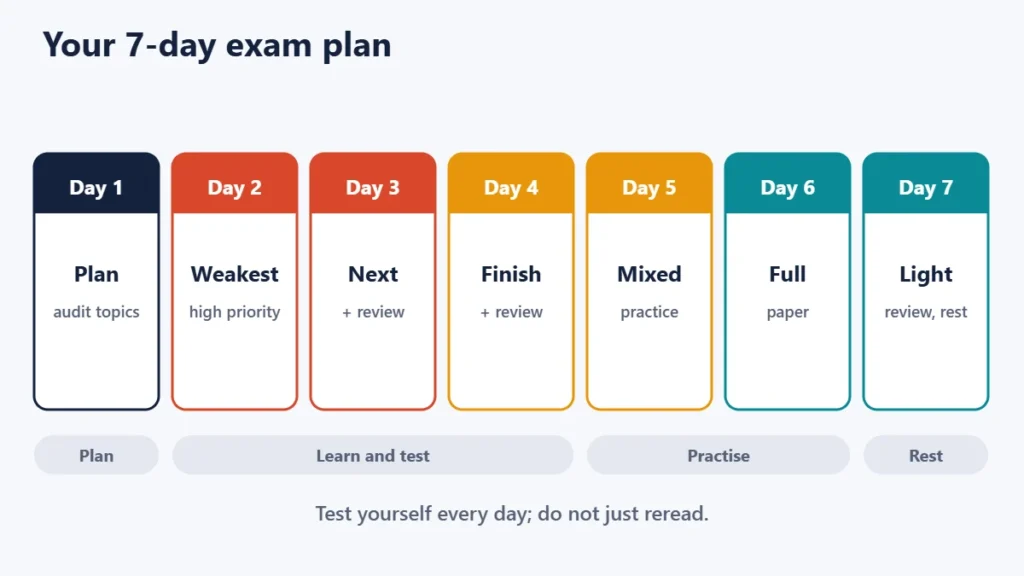
To study for an exam in 7 days, spend day 1 listing every topic and ranking them by importance and weakness, use days 2 to 5 to test yourself on those topics instead of rereading, take a full practice paper on day 6, and keep day 7 for light review and rest. Seven days is not long, but it is enough to make real progress if you spend the time on active practice and protect your sleep.
This guide gives you a day-by-day plan, a sample daily timetable, how to adjust for several subjects, what to do in each study session, and the mistakes that waste a week.
Key takeaways
- Start with a topic list. You cannot plan a week until you know what is in the syllabus.
- Prioritise topics that are both important and weak.
- Test yourself every day: past questions, flashcards and writing answers from memory.
- Revisit each topic more than once during the week instead of studying it only once.
- Keep the night before the exam light and get enough sleep.
The 7-day exam study plan at a glance
| Day | Focus | Main activities |
|---|---|---|
| Day 1 | Plan and audit | List all topics, rank them, gather past papers and notes, test yourself quickly on each topic |
| Day 2 | Weakest high-priority topics | Learn or relearn, make short notes and question cards, practise questions |
| Day 3 | Next priority topics + review day 2 | New topics, then a quick self-test on day 2’s topics |
| Day 4 | Remaining topics + review | Finish the topic list, review days 2 and 3 from memory |
| Day 5 | Mixed practice | Questions from all topics shuffled together, fix mistakes |
| Day 6 | Full practice paper | Timed paper in exam conditions, mark it, revise the gaps |
| Day 7 | Light review and rest | Short notes, formulas, key definitions; sleep early |
Day 1: audit the syllabus and rank your topics
Do not open a chapter and start reading on day 1. First, build your plan:
- List every topic in the syllabus or the chapters your teacher said will be tested.
- Gather your materials: textbook, class notes, past papers or sample papers, and any revision guides your school recommends.
- Quick-test yourself on each topic. Spend a few minutes writing what you remember, or try one past question. This shows you honestly what you know.
- Rank each topic using the grid below.
- Assign topics to days 2 to 4, starting with the top-priority ones.
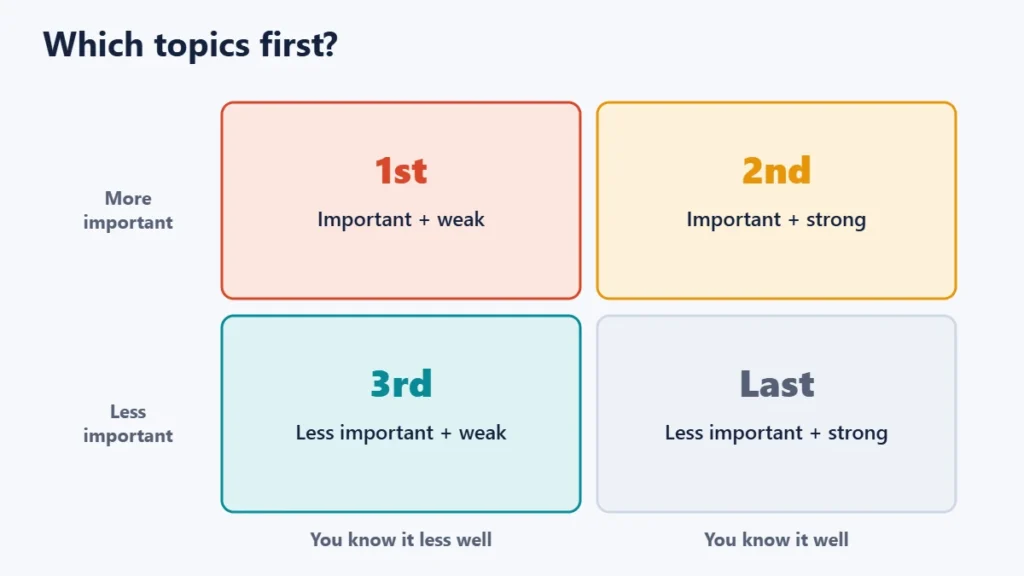
Importance can come from your teacher’s guidance, the syllabus, the marks given to each unit, or how often a topic appears in past papers.
Days 2 to 4: learn and test, one priority group at a time
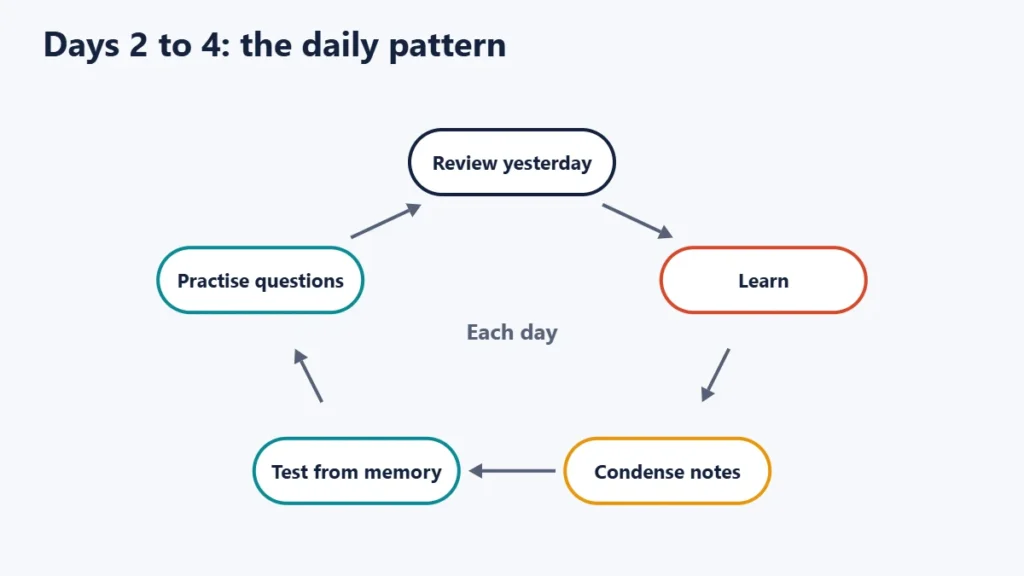
Each day, work through your assigned topics with this pattern:
- Learn: read the section or your notes once, carefully.
- Condense: make short notes or question cards. Our guide on how to make short notes for revision explains how.
- Test: close the book and write down everything you remember, then check. This is the blurting method.
- Practise: answer past or textbook questions on the topic.
- Review yesterday: before starting new topics, spend 20 to 30 minutes testing yourself on the previous day’s topics.
Revisiting topics on later days is a short version of spaced repetition. If you have more time in future, the 2357 method gives a longer spaced schedule.
Day 5: mixed practice
On day 5, stop studying one topic at a time. Shuffle questions from all your topics together, just as the exam will. This forces you to recognise what each question is asking before you answer it. Our guide to the interleaving study method explains why mixing helps. Mark every answer and note the topics where you still make mistakes.
Day 6: a full practice paper
- Use a past paper or sample paper if your board or school provides one.
- Sit it in exam conditions: timed, no notes, no phone.
- Mark it honestly using the marking scheme if available.
- Spend the rest of the day fixing the gaps the paper revealed.
Day 7: light review and rest
The day before the exam is for consolidation, not new learning:
- Read through your short notes, formulas and definitions.
- Do a few quick self-tests on your weakest topics.
- Prepare everything you need for the exam: admit card, pens, instruments, water.
- Stop early and get a full night’s sleep. Sleep is important for consolidating memory, so staying up all night usually backfires.
A sample daily timetable
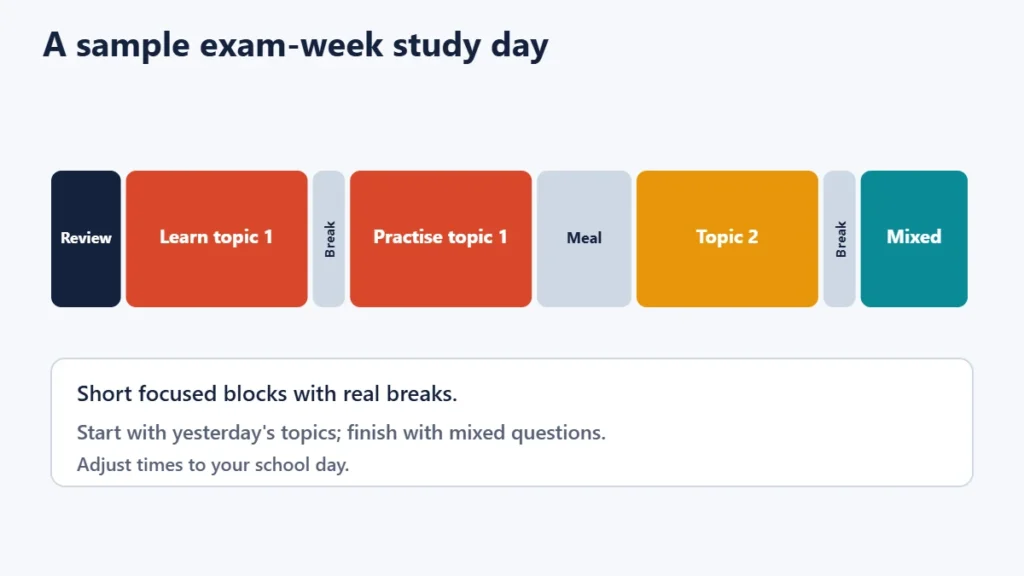
Here is an illustrative timetable for a school day during exam week, assuming you have about five to six hours for self-study. Adjust it to your own school hours and energy levels.
| Time | Activity |
|---|---|
| Block 1 (about 30 minutes) | Review yesterday’s topics from memory |
| Block 2 (about 75 minutes) | Priority topic: learn and make short notes |
| Break (about 15 minutes) | Move, drink water, no screens if possible |
| Block 3 (about 75 minutes) | Same topic: practice questions and self-test |
| Meal break | Proper break away from your desk |
| Block 4 (about 75 minutes) | Second topic: learn and practise |
| Break (about 15 minutes) | Rest |
| Block 5 (about 45 minutes) | Mixed questions and mistake log |
| Evening | Quick look at tomorrow’s plan, then wind down |
Studying several subjects in 7 days
If several exams fall in the same week, plan backwards from the dates:
- Give each subject at least a short daily slot so nothing goes untouched for days.
- Give more time to the subject whose exam comes first and to your weakest subject.
- Use the evening before each exam for that subject’s light review only.
- Keep a single topic list for each subject so you can see progress at a glance.
Common mistakes that waste the week
- Rereading everything. Reading feels productive but is much weaker than testing yourself.
- Starting with favourite topics. Begin with what is important and weak, not what is comfortable.
- Making beautiful notes all week. Notes are a tool, not the goal. Keep them short and spend most of the time practising.
- Skipping practice papers. Papers show you exactly what the exam expects.
- All-nighters. Losing sleep usually lowers performance on the day.
- Studying with your phone nearby. Keep it out of reach during study blocks.
Frequently asked questions
Is 7 days enough to study for an exam?
It depends on how much you already know and how large the syllabus is. Seven days is enough for a focused revision plan, especially if you have attended classes. If the syllabus is very large and largely new to you, prioritise the most important topics and accept that you may not cover everything in depth.
How many hours a day should I study in the last week?
There is no single right number. Many students manage around five to eight hours of focused study a day in exam week, split into short blocks with breaks. Quality of practice matters more than total hours.
Should I learn new topics in the last week?
On days 2 to 4, yes, if they are important. On the last day or two, focus on reviewing what you already know.
What should I do the night before the exam?
Review short notes and formulas lightly, prepare your materials, and sleep early. Avoid starting new chapters.
How do I stay motivated for seven days?
Tick topics off your list as you finish them, take proper breaks, and set a small reward for completing each day’s plan. Seeing your list shrink is a strong motivator.
Final word
A good 7-day plan replaces panic with a clear list: audit the syllabus on day 1, test yourself on priority topics on days 2 to 4, mix everything on day 5, sit a full paper on day 6, and rest on day 7. Spend your time recalling and practising rather than rereading, and you will walk into the exam knowing exactly where you stand.