
To write a summary of a chapter, read the whole chapter first, note the main idea of each section, then write a short version in your own words that covers only the key points, without adding opinions or minor details. A good chapter summary is usually about one-tenth of the original or less, and someone who has not read the chapter should still understand what it is about.
This guide gives you a seven-step method, a worked example from a school science chapter, a fill-in template, tips for textbooks versus storybooks, and the most common mistakes students make.
Key takeaways
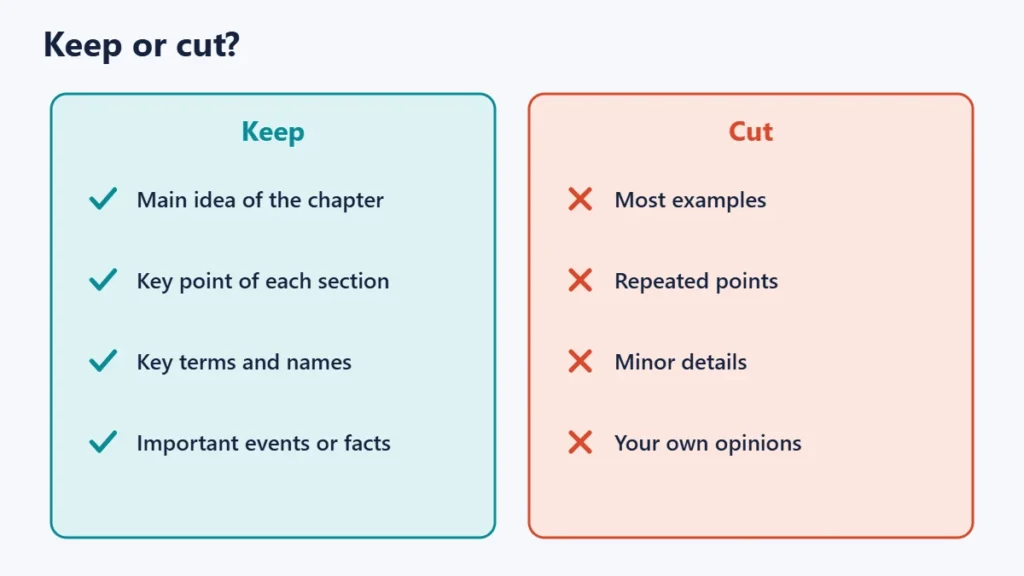
- A summary keeps the main ideas and drops examples, extra details and your opinions.
- Read the full chapter before you start writing.
- Use the chapter’s headings, bold terms and end-of-chapter questions to find the main points.
- Write in your own words. Copying sentences is not summarising.
- Check your summary against the chapter for accuracy before you finish.
What is a chapter summary?
A summary is a shorter version of a text that keeps its most important ideas in the same order of importance. It answers the question, “What is this chapter mainly about, and what are its key points?”
| A summary does | A summary does not |
|---|---|
| State the main idea of the chapter | Retell every detail or example |
| Cover each major section briefly | Add your personal opinion |
| Use your own words | Copy whole sentences from the book |
| Stay accurate to the original | Add facts that are not in the chapter |
| Keep key terms and names | Include minor side points |
How to write a summary of a chapter in 7 steps
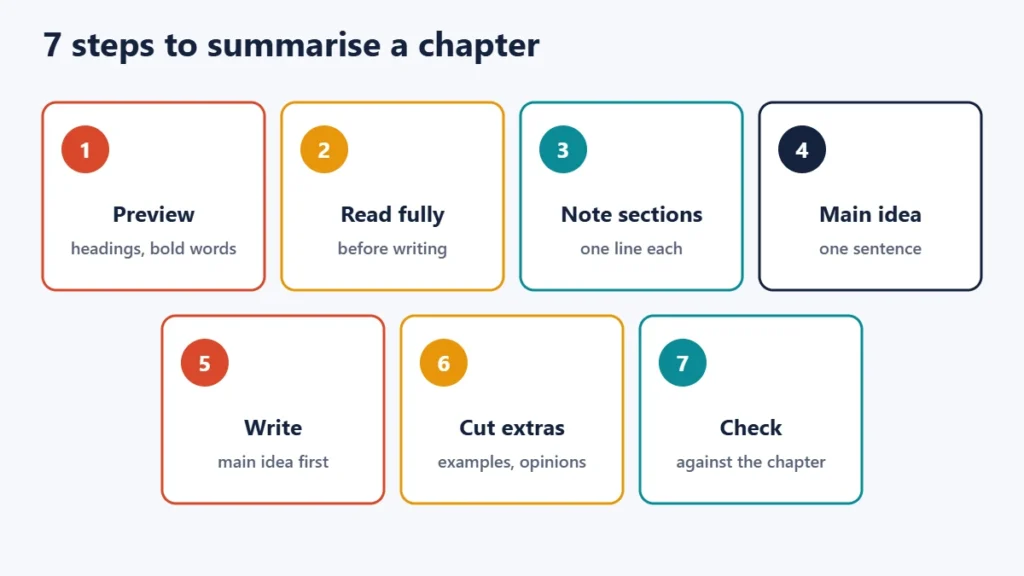
- Preview the chapter. Read the title, introduction, headings, bold words, diagrams and any end-of-chapter summary or questions. These show what the author thinks matters most.
- Read the whole chapter carefully. Do not start writing after the first page. You need the full picture to decide what is important.
- Note the main idea of each section. After each section, close the book and write one line in your own words: “This section explains…” If you cannot, reread that section.
- Find the chapter’s overall main idea. Look at your section notes and ask what connects them. Write it as one sentence.
- Write the summary. Start with the overall main idea, then cover each section’s key point in the order they appear, using linking words such as first, then, also, finally.
- Cut what is not essential. Remove examples, repeated points and anything that is your opinion.
- Check for accuracy. Compare your summary with the chapter. Is every point correct? Is anything important missing?
Step 3 is a form of active recall: writing the main idea from memory helps you understand and remember the chapter as well as summarise it. Learn more in our guides to active recall and spaced repetition and the blurting method.
How long should a chapter summary be?
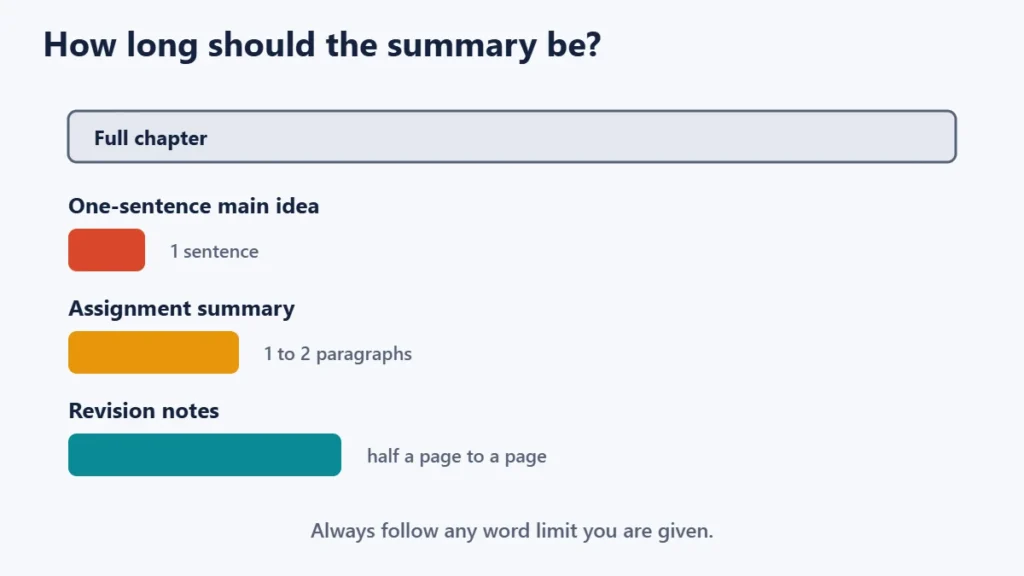
It depends on the purpose and any word limit you are given. As a rough guide:
- Revision notes for yourself: a few lines per section, often half a page to a page for a whole chapter.
- A school assignment: follow the word limit; if none is given, one or two paragraphs is common for a short chapter.
- A one-line summary: a single sentence stating the chapter’s main idea, useful as a starting point.
A useful check is that your summary should be much shorter than the chapter, often about a tenth of its length or less.
Worked example: a science chapter
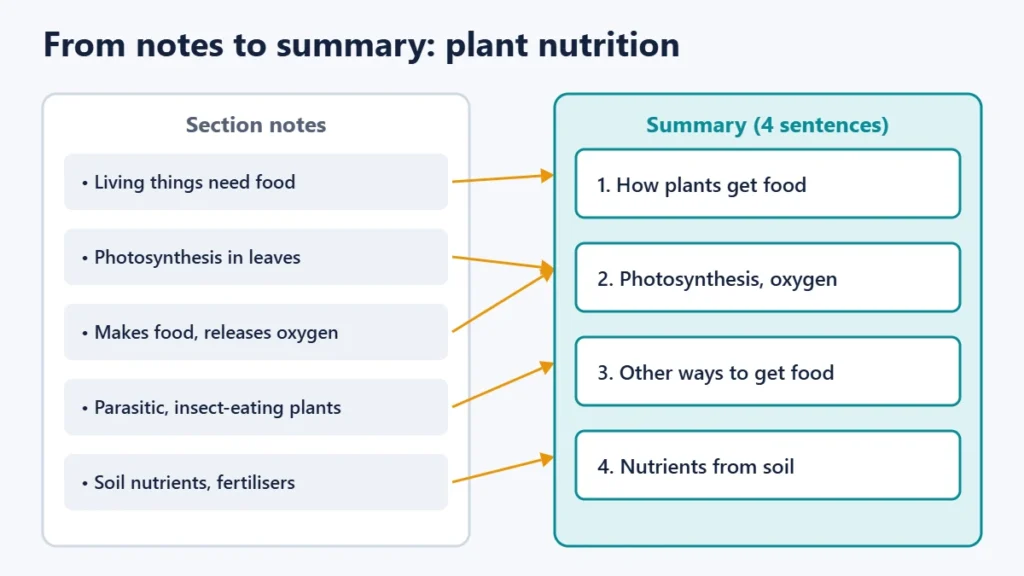
Here is an illustrative example written by The Study Cafe team for a Class 7 chapter on nutrition in plants.
Section notes:
- All living things need food for energy and growth.
- Plants make their own food by photosynthesis, using sunlight, water, carbon dioxide and chlorophyll in their leaves.
- Photosynthesis produces food (carbohydrates) and releases oxygen.
- Some plants get food in other ways, such as parasitic plants that take food from a host plant and insect-eating plants that trap insects.
- Plants also need nutrients from the soil, which farmers replace using manure and fertilisers.
Summary:
This chapter explains how plants get the food they need. Most plants make their own food through photosynthesis, a process in which leaves use chlorophyll and sunlight to turn water and carbon dioxide into food, releasing oxygen. Some plants obtain food in other ways: parasitic plants take it from a host, and insect-eating plants trap small insects. Plants also take nutrients from the soil, which farmers replenish with manure and fertilisers.
The summary is four sentences, keeps every key term, and leaves out the detailed examples the chapter uses to explain each idea.
A fill-in summary template
Chapter: ______________________________

Main idea (one sentence):
This chapter explains ___________________

Key points (one line each, in order):
1. ____________________________________
2. ____________________________________
3. ____________________________________
4. ____________________________________

Key terms to include:
______________________________________

Check: own words?  accurate?  no opinions?
Textbook chapters vs storybook chapters
| Textbook chapter | Story or novel chapter | |
|---|---|---|
| Focus on | Main concepts, definitions and processes | Main events, characters and what changes |
| Organise by | Section headings | Order of events |
| Keep | Key terms and important facts | Who did what, where and why it matters to the plot |
| Leave out | Worked examples, side boxes, extra trivia | Minor dialogue and description |
| Tense | Present (“The chapter explains…”) | Usually present (“Ravi decides to…”) |
Common mistakes
- Starting to write too early. Summarising page by page as you read usually produces a long retelling, not a summary.
- Copying sentences from the book. This does not show understanding and can count as plagiarism in assignments.
- Including every example. Keep the idea, drop most examples.
- Adding opinions. “I found this chapter interesting” belongs in a review or response, not a summary.
- Changing the meaning. Shortening must not make a point inaccurate. Always check against the original.
- Forgetting key terms. Important words like “photosynthesis” or “chlorophyll” should stay in.
Using chapter summaries for revision
Writing a summary is also an excellent way to study. Try writing it from memory first, then check it against the chapter and fix any gaps. Many students add a summary box at the bottom of each page of their notes, as in the Cornell note-taking method. If you need to write the summary as part of a longer answer, our guide on how to write a paragraph will help you keep it clear and well organised.
Frequently asked questions
How do you start a chapter summary?
Start with one sentence stating the chapter’s main idea, for example “This chapter explains how…” or “In this chapter, the main character…”.
Should a summary be in my own words?
Yes. Keep key terms and names, but explain the ideas in your own sentences.
Can I include my opinion in a summary?
No. A summary reports what the chapter says. If your teacher asks for your views, write them in a separate response or review.
What is the difference between a summary and notes?
Notes can be bullet points and fragments. A summary is written in full sentences as a short, connected piece of writing.
How do I summarise a very long chapter?
Summarise each section in one or two lines first, then combine those lines into a short paragraph or two.
Summary of this guide
Read the whole chapter, note the main idea of each section in your own words, find the overall main idea, then write a short, accurate summary that keeps the key points and drops examples and opinions. Check it against the chapter, and you will have a summary that helps both your assignment and your revision.