Active recall means testing yourself: you close the book and pull the answer out of your memory instead of reading it again. Spaced repetition means reviewing the same material several times with growing gaps between sessions, instead of cramming it all in one sitting. Used together, they form one of the best-supported study methods in learning research: you quiz yourself, and you repeat those quizzes on a spread-out schedule.
This guide explains what each technique is, why it works, and exactly how to build a weekly routine around it, with a worked example for a school chapter, a printable-style schedule, common mistakes and an original practice exercise.
Key takeaways
- Rereading and highlighting feel productive but are weak ways to remember. Retrieving the answer yourself is stronger.
- A large 2013 review of ten study techniques rated only two as “high utility”: practice testing (active recall) and distributed practice (spaced repetition).
- Spread reviews out: for example, the day after learning, then a few days later, then a week or two later.
- Always check your answers after recalling them. Feedback fixes mistakes before they stick.
- The method feels harder than rereading. That effort is part of why it works.
Active recall vs spaced repetition: what is the difference?
The two ideas are often mentioned together, but they answer different questions. Active recall is about how you review. Spaced repetition is about when you review.
| Active recall | Spaced repetition | |
|---|---|---|
| Question it answers | How should I review? | When should I review? |
| Core action | Answer from memory before looking | Revisit material after increasing gaps |
| Other names | Retrieval practice, practice testing, self-testing | Distributed practice, spaced practice, the spacing effect |
| Opposite habit | Rereading notes, highlighting | Cramming everything the night before |
| Simple example | Covering the answer side of a flashcard and saying the answer aloud | Reviewing those flashcards on day 1, day 3, day 7 and day 21 |
You can use either one alone. Self-testing once is better than rereading once, and spacing out rereading is better than cramming it. The real gain comes from combining them: spaced sessions of self-testing.
What the research says
These are not new study hacks. Psychologists have studied both effects for more than a century, and the findings have been repeated many times with students of different ages.
The 2013 review of ten study techniques
In 2013, John Dunlosky and four colleagues published a long review in the journal Psychological Science in the Public Interest. They looked at ten common study techniques and rated how useful each one is, based on the available evidence. Only two received their top “high utility” rating: practice testing and distributed practice. Highlighting, rereading and summarising were among the techniques rated “low utility”, even though many students rely on them.
The authors were careful to add that no technique is a cure-all. A method only helps students who actually use it, and use it properly.
Testing yourself beats studying again
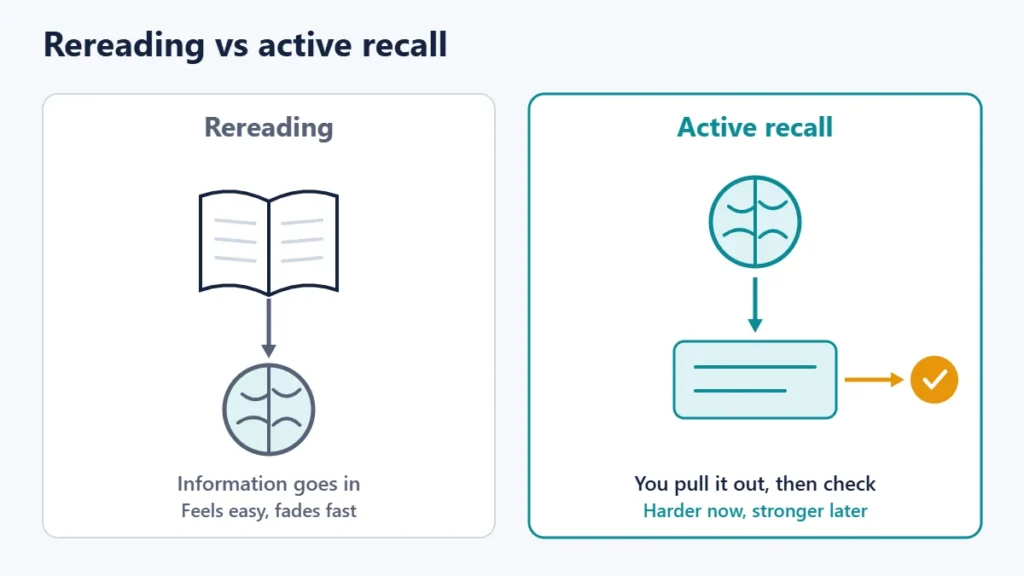
A well-known 2006 experiment by Henry Roediger and Jeffrey Karpicke at Washington University in St. Louis asked students to learn short prose passages. Some students reread the passage, while others took recall tests on it. On a test five minutes later, rereading looked slightly better. But when students were tested two days or one week later, the pattern flipped: the students who had practised recalling the passage remembered more.
This is an important lesson. A method that feels good during a study session is not always the method that works best by exam day.
Spacing your reviews
The spacing effect goes back to Hermann Ebbinghaus’s memory experiments in the 1880s. A 2006 analysis led by Nicholas Cepeda combined results from hundreds of experiments and found that spreading practice out generally leads to better long-term memory than massing it together.
A follow-up study in 2008, with more than 1,350 participants, looked at how long the gap between reviews should be. Its answer was that the best gap depends on how long you need to remember the material. When the final test was one week away, the best gap was roughly 20 to 40 percent of that delay. When the test was a year away, the best gap was roughly 5 to 10 percent of the delay. In plain terms: the further away your exam, the longer you can wait between reviews, though not in exact proportion.
Why does it work?
Researchers still debate the exact mechanisms, but three explanations are widely discussed:
- Retrieval strengthens memory. Each time you successfully recall something, you make it easier to recall again. Reading only shows you the information; recall makes your brain rebuild it.
- Effort helps, within limits. Psychologists Robert and Elizabeth Bjork call this a “desirable difficulty”. Recalling something you have half forgotten takes effort, and that effort tends to strengthen the memory more than an easy review would.
- You find your gaps. Rereading creates an illusion of knowing, because the page looks familiar. A blank page tells you honestly what you do not know yet.
How to use active recall: six practical methods
Active recall does not need any special app. Anything that makes you produce an answer before you see it counts.
- Flashcards. Write a question on one side and the answer on the other. Say or write your answer before you flip the card.
- Blank page recall. After reading a topic, close the book and write down everything you remember on a blank sheet. Then open the book and fill in what you missed in a different colour.
- Question-first notes. Turn each heading in your textbook into a question. “Causes of the French Revolution” becomes “What were three causes of the French Revolution?”
- Practice papers and end-of-chapter questions. Answer them without notes first, then mark your work.
- Teach it. Explain the topic aloud to a friend, a family member or an empty room, as if they know nothing about it.
- Cover and recall diagrams. Hide the labels on a diagram, such as the parts of a plant cell, and name each part before uncovering it.
Whatever method you choose, the key rule is the same: try first, then check. The Dunlosky review noted that testing with feedback produces the strongest learning, so always compare your answer with the correct one and fix errors straight away.
How to build a spaced repetition schedule
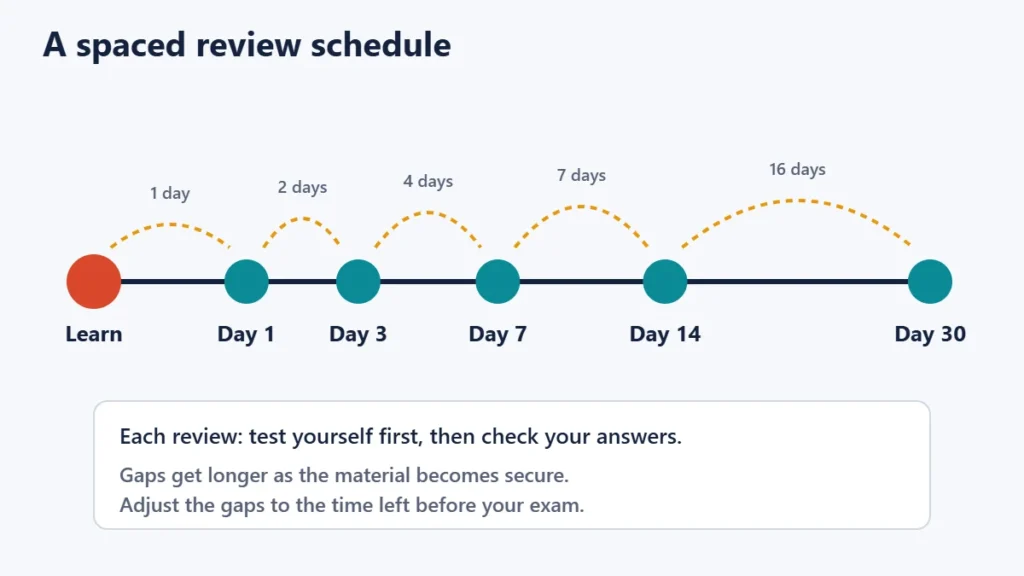
There is no single perfect schedule. The research supports the principle of growing gaps, not a magic set of days. A simple, practical pattern for school and college students is:
| Review | When | What to do |
|---|---|---|
| Learn | Day 0 | Study the topic and make question cards or a question list |
| Review 1 | Day 1 | Blank page recall, then check |
| Review 2 | Day 3 | Flashcards or questions, mark the ones you miss |
| Review 3 | Day 7 | Mixed questions from this and earlier topics |
| Review 4 | Day 14 to 21 | Practice paper or timed questions |
| Review 5 | About a month later | Quick check; keep only weak cards in rotation |
Adjust the gaps to your exam date. If the exam is two weeks away, compress the plan. If it is months away, you can stretch the later gaps. Cards you keep getting right can be reviewed less often; cards you keep missing should come back sooner.
The Leitner box method (no app needed)
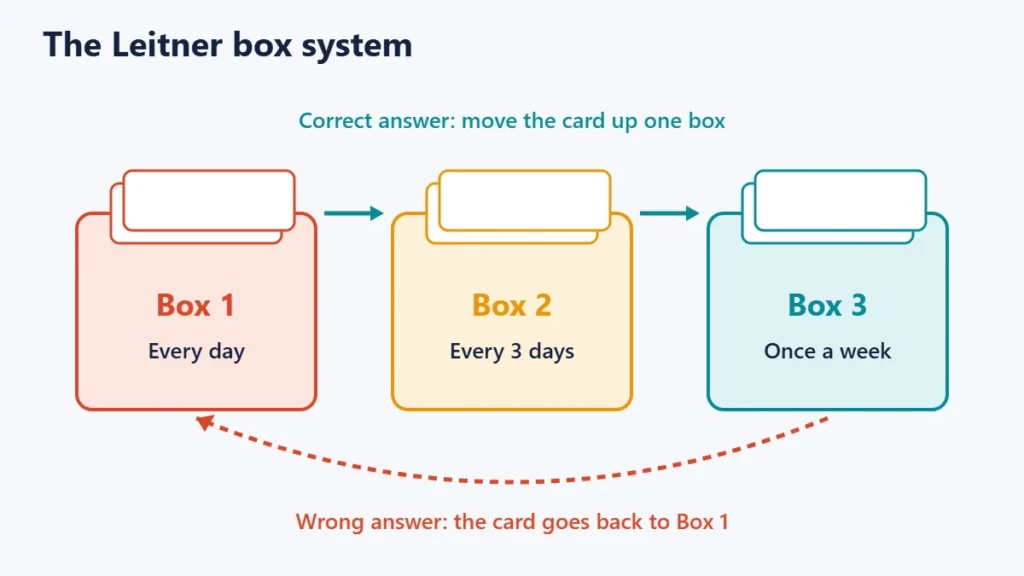
German science journalist Sebastian Leitner popularised a simple paper system in the 1970s. You need three to five boxes or envelopes:
- All new cards start in Box 1, which you review every day.
- When you answer a card correctly, move it up one box. Box 2 is reviewed every few days, Box 3 once a week, and so on.
- When you get a card wrong, move it back to Box 1, however high it was.
This automatically gives more practice to the material you find hardest, and less to what you already know well. Flashcard apps that use spaced repetition work on the same idea, but schedule the reviews for you.
Worked example: one science chapter over three weeks
Here is how a Class 9 student might use the method for a chapter on the cell. This is an illustrative plan, not an official syllabus.
- Monday (day 0): Read the chapter once, carefully. Turn each heading into a question: “What does the cell membrane do?”, “How is a plant cell different from an animal cell?”, “What is the function of mitochondria?” Write 15 to 20 question cards.
- Tuesday (day 1): Without opening the book, draw and label a plant cell and an animal cell. Check against the textbook. Mark three cards you could not answer.
- Thursday (day 3): Go through all cards. Put correct ones aside and repeat the missed ones until you get each right once.
- Next Monday (day 7): Answer the end-of-chapter questions without notes. Add a few cards from last week’s topic to mix things up.
- Two weeks later (day 21): Do a timed set of questions from the chapter. Only the cards you still miss stay in the daily pile.
Notice what the student did not do: reread the chapter five times. Most of the time was spent answering questions.
Combining both into a weekly routine
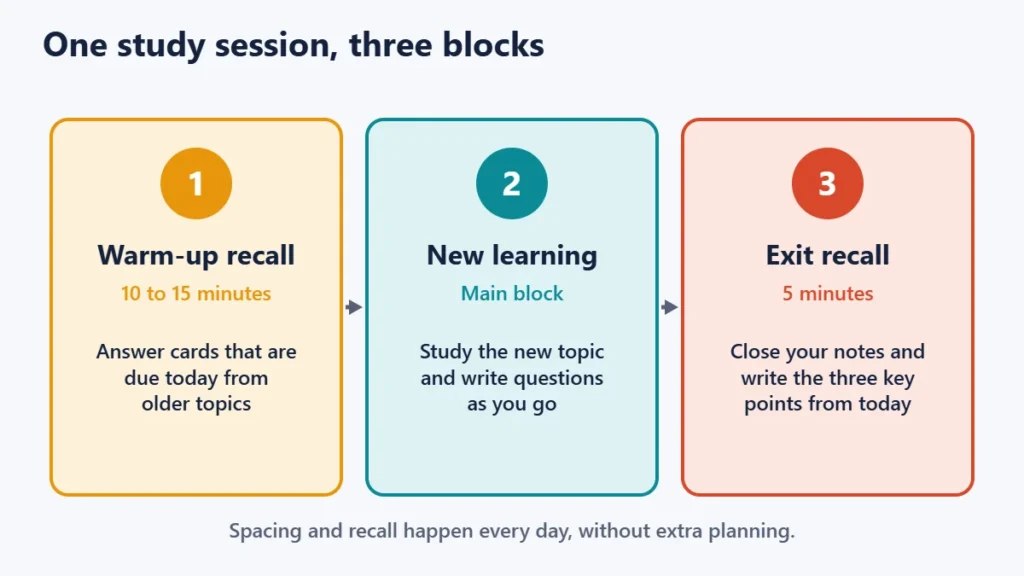
When you study several subjects, the easiest approach is to start every study session with a short review block before learning anything new:
- Warm-up recall (10 to 15 minutes): answer cards or questions that are due today from older topics.
- New learning (main block): study the new topic and create questions as you go.
- Exit recall (5 minutes): close your notes and write the three most important points from today’s topic.
Over a week, this naturally mixes subjects and topics, which also gives you practice at choosing the right method for each question. Researchers call this mixing interleaving, which the 2013 review rated “moderate utility”.
Common mistakes to avoid
- Peeking too early. If you flip the card before really trying, you are rereading, not recalling. Give yourself a genuine attempt first, even if it is a guess.
- Skipping the check. Recall without feedback can strengthen wrong answers. Always mark your attempt.
- Making cards too big. “Explain photosynthesis” is a whole essay. Break it into several smaller questions, then practise the full explanation separately.
- Only memorising definitions. Include “why” and “how” questions, and practise applying ideas to new problems, not just repeating words.
- Dropping cards too soon. Getting a card right once on the same day does not mean you will remember it next month. Let the schedule bring it back.
- Starting too late. Spacing needs time. Even a few days of spaced reviews beats one night of cramming, but starting weeks before the exam is better still.
- Judging by how it feels. Recall feels harder and slower than rereading. That does not mean it is working less well.
Practice exercise (original, for self-checking)
Try active recall on this article right now. Cover the page above, and answer these questions from memory. Then scroll up and check.
- What is the difference between active recall and spaced repetition in one sentence each?
- Which two techniques did the 2013 review rate as “high utility”?
- In the 2006 Roediger and Karpicke study, which group did better on the test one week later?
- In the Leitner system, what happens to a card you answer wrongly?
- Name two common mistakes when using flashcards.
If you missed any, that is normal. Mark them, and try the same questions again in two or three days.
Frequently asked questions
Is active recall better than making notes?
They do different jobs. Notes help you organise material while you learn it. Active recall helps you remember it. The best approach is to write notes in a way that supports recall, for example with questions in the margin, and then test yourself from them instead of just rereading.
How many times should I review a topic?
Research does not set a fixed number. A practical starting point is four or five spaced reviews before an exam, with more for topics you keep getting wrong. Stop reviewing a card often only when you can answer it correctly after a long gap.
Do I need an app for spaced repetition?
No. Paper flashcards with the Leitner box method work well. Apps can be convenient because they schedule reviews automatically, but the learning comes from the recall and the spacing, not the software.
Does this work for maths and problem-solving subjects?
Yes, but the “recall” should be solving problems, not memorising solutions. Work a problem without looking at the method, check it, and return to similar problems a few days later. Mixing different types of problems in one session is especially useful.
Can I use active recall the night before an exam?
Self-testing the night before is better than rereading, but you lose the benefit of spacing. If you only have a short time, test yourself on the most important topics, check your answers, and get some sleep rather than staying up all night.
What if I keep forgetting the same thing?
Make the card smaller, write the answer in your own words, and connect it to something you already know. Then bring it back more often until it sticks.
Conclusion
If you take one idea from this guide, make it this: spend less time reading your notes and more time testing yourself on them, a little at a time, over several days and weeks. Start with your next chapter. Write questions as you study, recall the answers the next day, and let the gaps grow. The method takes more effort per minute than rereading, but research shows that effort pays off when it matters most.
For writing practice alongside your revision, browse our collection of sample essays and try summarising one from memory, such as our essay on discipline or our essay on education.