
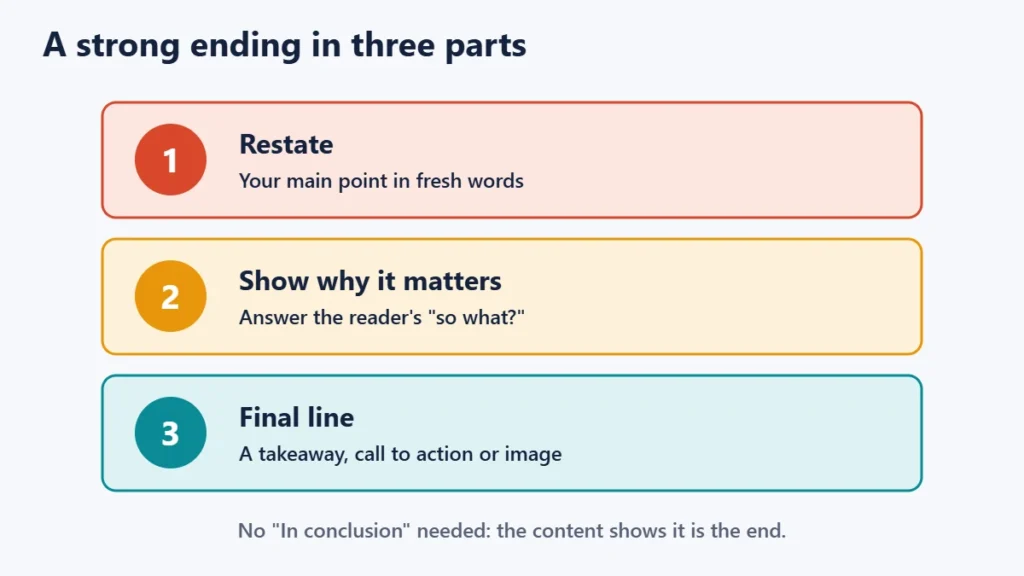
You can end an essay without writing “In conclusion” by simply starting your final paragraph with the conclusion itself: restate your main point in fresh words, show why it matters, and finish with a strong final line. Readers can see they have reached the last paragraph, so a label is not needed. If you want a linking word, choose a quieter one such as “ultimately” or “overall”.
This guide gives you eight ways to end an essay, alternatives to “In conclusion”, examples for different essay types, and the mistakes that make endings weak.
Key takeaways
- Your conclusion is the last thing the reader sees, so make the final sentence count.
- Phrases like “In conclusion” and “To sum up” are not wrong, but they are overused and add nothing.
- Good endings restate the main idea in new words, then add a final thought: a takeaway, a call to action, a look ahead or a link back to the opening.
- Never introduce a brand-new argument in the conclusion.
- Follow your teacher’s instructions: some school formats expect a signal phrase.
Why avoid “In conclusion”?
There is nothing grammatically wrong with “In conclusion”. The problem is that it is so common that it sounds mechanical, and it tells the reader something they already know. It also tempts writers into a lazy summary: “In conclusion, there are many advantages and disadvantages of mobile phones.” A stronger ending does the work instead of announcing it.
That said, some teachers and exam formats, especially for younger students, expect a clear signal phrase. If your teacher asks for one, use it. You can still make the sentence after it strong.
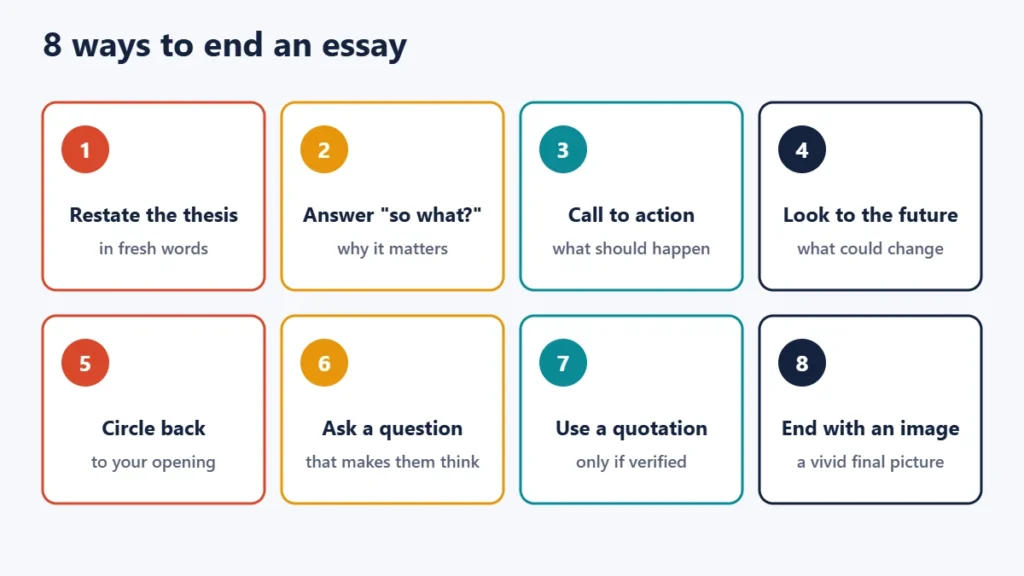
8 ways to end an essay
All the examples below were written by The Study Cafe team for an essay arguing that schools should teach students how to manage money.
1. Restate the thesis in fresh words
Do not copy your introduction. Say the same idea in a new way, now that the reader has seen your evidence.
Example: “Knowing how to budget, save and avoid debt is as important for a teenager’s future as knowing algebra or grammar.”
2. Answer “So what?”
Explain why your argument matters, to the reader, to society or to the future.
Example: “Without these lessons, many young people learn about money the hard way, through debts they did not understand.”
3. End with a call to action
Tell the reader what should happen next. This suits persuasive and argumentative essays.
Example: “Schools could start small, with one period a week on everyday money skills, and build from there.”
4. Look to the future
Describe what could change if your argument is accepted.
Example: “A generation that understands money could make smarter choices about education, careers and family life.”
5. Circle back to the opening
If your introduction began with a story, question or image, return to it. This gives the essay a sense of completeness.
Example: “Ravi, who once spent his whole month’s pocket money in a week, now keeps a small notebook of every rupee he spends.” (Ravi is an illustrative character.)
6. End with a question for the reader
A thoughtful question can leave the reader thinking. Use it sparingly, and only if your argument has already been made clearly.
Example: “If we expect young people to manage their own money one day, why do we wait until they are adults to teach them how?”
7. Use a relevant quotation, carefully
A short, well-chosen quotation can work, but only if you know who said it and it adds something. Do not use a quote just to fill space, and never invent or misattribute one.
8. End with a vivid image
In descriptive and narrative essays, a concrete final picture is often stronger than a summary.
Example for a “My Favourite Place” essay: “As the sun sets behind the hills, the old banyan tree’s shadow stretches across the field, and I know I will come back.”
Alternatives to “In conclusion”
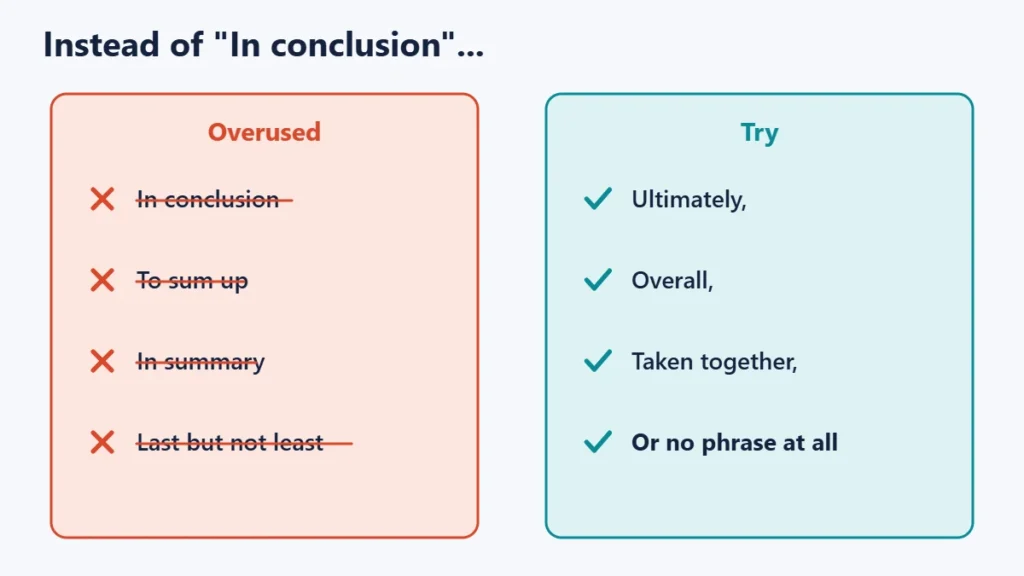
If you want a linking word, these sound less mechanical. The simplest option is often to use none at all.
| Instead of | Try | Best used when |
|---|---|---|
| In conclusion | Ultimately | You are stating the final judgement |
| To sum up | Overall | You are weighing several points together |
| In summary | Taken together | Your points combine into one idea |
| Finally | In the end | You are finishing a story or sequence |
| Thus | For these reasons | You are drawing a judgement from reasons given |
| In conclusion | (no phrase) | Start directly with your restated main point |
Matching the ending to the essay type
| Essay type | Good ending styles |
|---|---|
| Argumentative or persuasive | Restate the position, answer “so what?”, call to action |
| Expository (explaining a topic) | Restate the key idea, show why it matters, look to the future |
| Narrative (a story) | Reflection on what you learned, circle back to the opening |
| Descriptive | A vivid final image, a feeling or a reflection |
Before and after: improving a weak conclusion
Weak: In conclusion, money management is important. There are many reasons why schools should teach it. This is why I think schools should teach money management.
Improved: Teaching students to budget, save and borrow wisely would give them skills they will use every week of their adult lives. The cost is small: a few lessons a term. The benefit could be a generation that makes confident, informed decisions about money. It is time money skills found a place on the timetable.
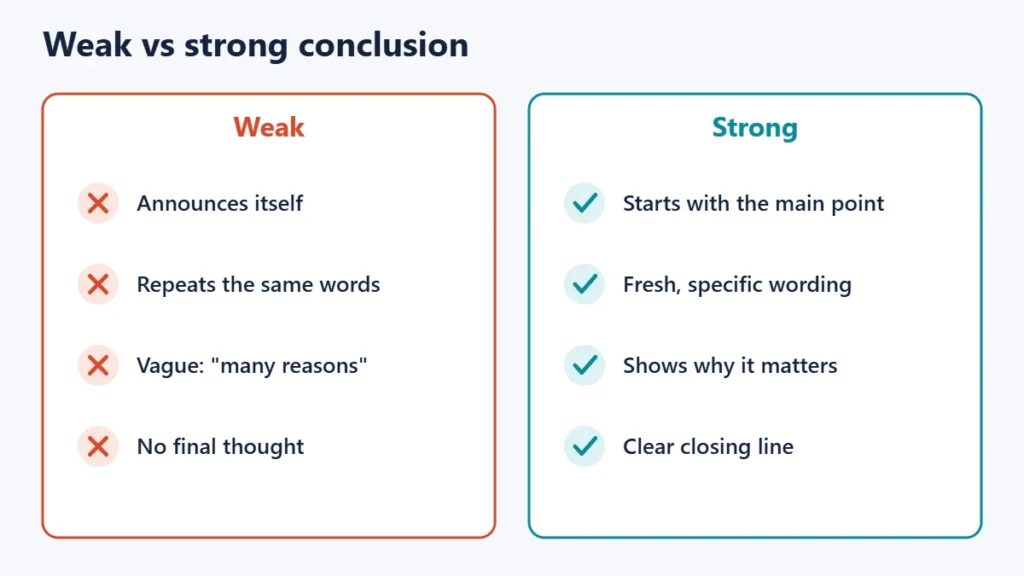
What changed:
- “In conclusion” was dropped, and the paragraph starts with the main idea.
- Repetition (“important”, “many reasons”, “this is why”) was replaced with specific benefits.
- The last sentence gives a clear, confident final thought.
Common mistakes in essay endings
- Adding a new argument. If a point is important, it belongs in a body paragraph.
- Copying the introduction word for word. Restate, do not repeat.
- Apologising or weakening your point. Avoid lines like “This is just my opinion” or “I may be wrong”.
- Ending too suddenly. One sentence is rarely enough for a conclusion in a school essay; three to five is common.
- Overused clichés. Lines like “Last but not least” or “All in all, it was a wonderful day” make an ending forgettable.
Practice exercise (original)
Here is a weak conclusion from an essay on saving water: “In conclusion, water is very important and we should save it. Water is life. We must save water.”
- Rewrite it without “In conclusion”.
- Use at least two of the eight endings above.
- Keep it to three or four sentences.
One possible answer: “Every drop we save today is water that our towns and farms can rely on tomorrow. Simple habits, such as turning off the tap while brushing and fixing leaks quickly, cost nothing but add up across millions of homes. If each family made just one change this week, the difference would be impossible to ignore.”
Frequently asked questions
Is it wrong to use “In conclusion” in an essay?
No, it is not wrong, and some teachers expect it. It is just overused. Many writers find their endings are stronger when they leave it out or use a quieter phrase.
How long should an essay conclusion be?
For most school essays, three to five sentences, or roughly the same length as your introduction.
Can I end an essay with a question?
Yes, if your argument is already clear and the question makes the reader think further. Avoid ending with a question that your essay has not answered.
Should a conclusion include new information?
No. A conclusion pulls your ideas together. New arguments or evidence belong in the body of the essay.
What is the best last sentence for an essay?
One that is specific to your topic and leaves a clear final thought: a takeaway, a call to action, a look ahead or a link back to your opening. Avoid general lines that could end any essay.
Final thought
You do not need “In conclusion” to show that your essay is ending. Start your final paragraph with your main point in fresh words, show why it matters, and finish with one sentence that the reader will remember. For the full structure of an essay, see our guide on how to write an essay, and for building strong body paragraphs, see how to write a paragraph. You can also practise by rewriting the endings of our sample essays.