
To write a good essay, follow five steps: understand the question, plan your main points, write an introduction with a clear thesis, develop one idea per body paragraph, and finish with a conclusion that ties everything together. Then leave time to check and edit. Almost every school and college essay, whatever the topic, uses this same basic structure of introduction, body and conclusion.
This guide walks you through each step with examples, a ready-to-use essay format, an outline template, a short sample essay built from that outline, and a checklist you can use before you hand your work in.
Key takeaways
- An essay has three parts: an introduction, body paragraphs and a conclusion.
- The thesis statement is the one or two sentences that tell the reader your main point. Everything else supports it.
- Each body paragraph should make one point, explain it, and back it with an example.
- Planning for a few minutes before you write usually saves time and produces a clearer essay.
- Editing is part of writing. Read your essay again before you submit it.
What is an essay?
An essay is a short piece of writing on a single topic that presents the writer’s ideas in an organised way. Teachers set essays to see whether you can think about a subject, organise your thoughts and express them clearly. That is why a well-structured essay with simple language usually scores better than a long one full of difficult words but no clear point.
Most essays you will write at school fall into four broad types:
| Type | Purpose | Example topic |
|---|---|---|
| Descriptive | Paint a picture of a person, place or thing | My classroom |
| Narrative | Tell a story or describe an experience | A memorable trip |
| Expository | Explain a topic using facts | Causes of deforestation |
| Argumentative or persuasive | Take a side and convince the reader | Should mobile phones be allowed in school? |
The steps below work for all four types. Only the focus of your body paragraphs changes.
The basic essay format
Here is the standard structure. For a short school essay of 300 to 500 words, three body paragraphs is a sensible starting point, which is why this is often called the five-paragraph essay. Longer essays simply have more body paragraphs.
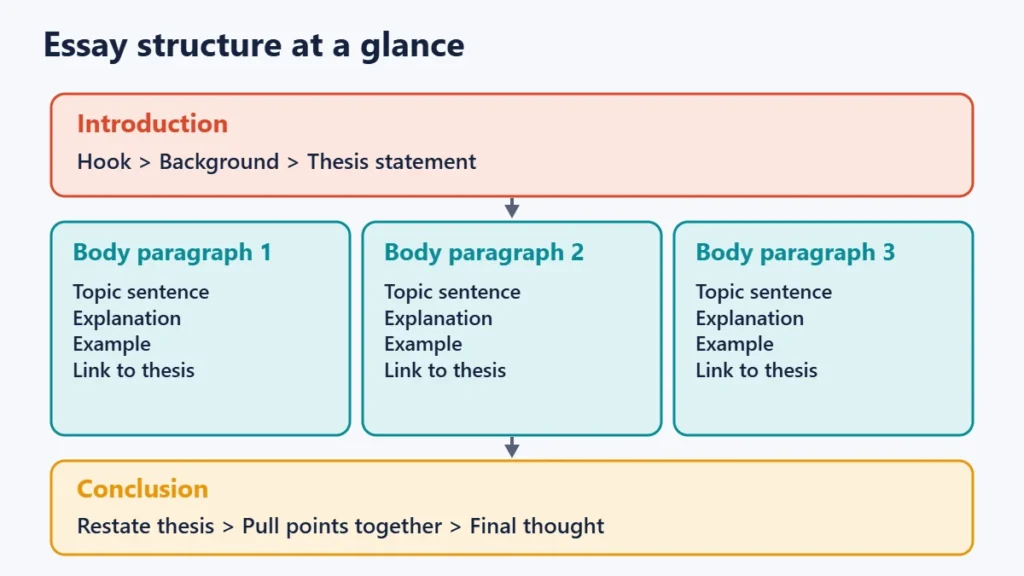
- Title: short and clear, often given by your teacher.
- Introduction (about 10 to 15 percent): a hook to catch interest, one or two sentences of background, and your thesis statement.
- Body paragraphs (about 70 to 80 percent): each one makes a single point that supports your thesis.
- Conclusion (about 10 percent): sums up your main point in fresh words and leaves the reader with a final thought.
These proportions are a guide, not a rule. Always follow any word limit or format your teacher or exam board gives.
Step 1: Understand the question
Many weak essays are well written but answer the wrong question. Before you write anything, read the topic twice and underline:
- The subject: what the essay is about, for example “the internet”.
- The task word: what you have to do with it. “Describe” asks for details. “Explain” asks how or why. “Discuss” asks you to look at different sides. “Do you agree?” asks for your opinion with reasons.
- The limits: the word count, time and any specific points you must include.
For example, “The internet: a boon or a bane?” is not asking you to describe what the internet is. It asks you to weigh its benefits against its harms and reach a judgement.
Step 2: Brainstorm and plan
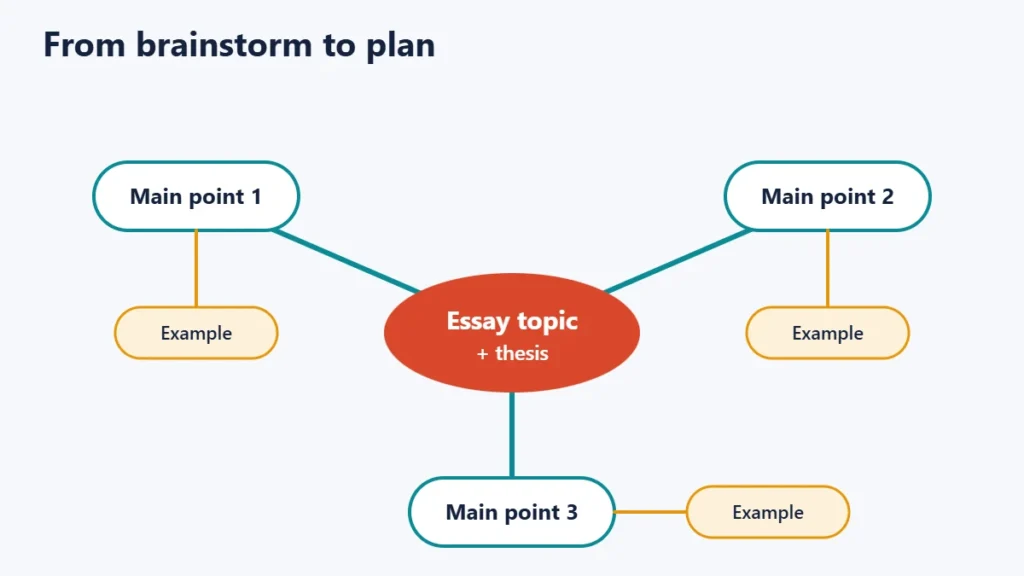
Spend a few minutes jotting down every idea that comes to mind. Do not worry about order yet. Then:
- Group similar ideas together.
- Pick the three strongest groups. These become your body paragraphs.
- For each one, note one example, fact or short story that supports it.
- Decide the order. A common choice is to put your second-strongest point first and your strongest point last.
In an exam, a few minutes of planning for a 30-minute essay is time well spent, because you will not get stuck halfway through.
Step 3: Write a clear thesis statement
The thesis statement is the most important sentence in your essay. It tells the reader, in one or two sentences, what you are going to argue or explain. The Writing Center at the University of North Carolina at Chapel Hill warns that thesis statements that are too vague often lack a strong argument, so aim for a specific claim rather than simply stating a fact or announcing the topic.
| Weak thesis | Why it is weak | Stronger thesis |
|---|---|---|
| This essay is about reading books. | Only announces the topic | Reading books regularly makes students better learners because it builds vocabulary, concentration and imagination. |
| Pollution is bad. | Too vague; nobody disagrees | Firecracker pollution during festivals harms children and older people most, so communities should switch to greener celebrations. |
| Mobile phones have advantages and disadvantages. | Does not take a position | Schools should allow phones only for supervised learning activities, because unlimited use distracts students more than it helps them. |
A useful trick: a strong thesis often answers the question “how?” or “why?” and previews your main points. The stronger examples above each list the reasons that the body paragraphs will develop.
Step 4: Write the introduction
The introduction has three jobs: catch the reader’s interest, give a little context, and state your thesis. Keep it short.
- Hook: open with a question, a striking fact you can support, a short scene, or a well-known saying. Avoid starting every essay with a dictionary definition.
- Background: one or two sentences that connect the hook to your topic.
- Thesis: usually the last sentence of the introduction.
If you find the introduction hard, write the body first and come back to it. It is easier to introduce an essay once you know what it says.
Step 5: Build strong body paragraphs
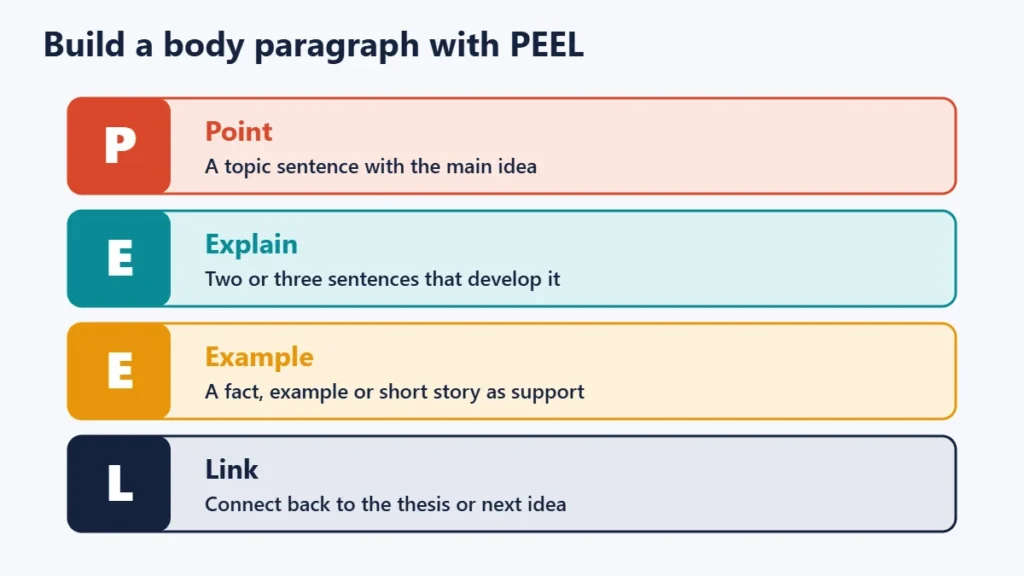
Each body paragraph should focus on one main point. A simple way to remember the structure is PEEL:
- P – Point: a topic sentence that states the paragraph’s main idea.
- E – Explain: two or three sentences that develop the idea.
- E – Example: a fact, example, quotation or short story that supports it.
- L – Link: a closing sentence that connects back to your thesis or leads into the next paragraph.
Use transition words to help the reader follow your argument: firstly, in addition, for example, however, on the other hand, as a result, finally. Purdue University’s Online Writing Lab compares transitions to the mortar that holds an essay’s structure together.
Step 6: Write the conclusion
A good conclusion does three things:
- Restates the thesis in new words. Do not copy your introduction.
- Briefly pulls together your main points, showing how they add up.
- Ends with a final thought: a suggestion, a call to action, a look to the future, or a reflection on why the topic matters.
Do not introduce a brand-new argument in the conclusion. If an idea is important enough to include, it belongs in a body paragraph.
Step 7: Edit and proofread
Leave a few minutes at the end, or a day if you are writing at home, and read your essay again. Check the big things first, then the small ones:
- Does every paragraph support the thesis?
- Is each paragraph about one main idea?
- Are the paragraphs in a sensible order with clear transitions?
- Are any sentences too long or confusing? Split them.
- Are spelling, punctuation, capital letters and tenses correct?
- Are you within the word limit?
Reading your essay aloud, even quietly, is one of the easiest ways to catch awkward sentences and missing words.
Essay outline template
Copy this outline into your notebook and fill it in before you start writing.
Title: ______________________________

INTRODUCTION
  Hook: ______________________________
  Background: ________________________
  Thesis: ____________________________

BODY PARAGRAPH 1
  Point: _____________________________
  Example: ___________________________

BODY PARAGRAPH 2
  Point: _____________________________
  Example: ___________________________

BODY PARAGRAPH 3
  Point: _____________________________
  Example: ___________________________

CONCLUSION
  Restated thesis: ____________________
  Final thought: ______________________
Sample essay: from outline to finished essay
Below is a short illustrative essay written by The Study Cafe team to show the steps in action. It is a learning example, so use it to understand the structure, not to copy for an assignment.
The outline
- Thesis: Reading books regularly makes students better learners because it builds vocabulary, concentration and imagination.
- Point 1: Vocabulary – meeting new words in context.
- Point 2: Concentration – a book asks for sustained attention.
- Point 3: Imagination – stories let you picture other lives and places.
- Final thought: Start with just 15 minutes a day.
The essay: Why Every Student Should Read Books
How many new words did you learn last week without opening a dictionary? For students who read regularly, the answer may be more than they think. In an age of short videos and quick messages, books can seem slow. Yet reading books regularly makes students better learners, because it builds vocabulary, concentration and imagination.
Firstly, books are one of the best ways to grow your vocabulary. When you meet a new word in a story, the sentences around it often hint at its meaning. For example, a reader who comes across “the exhausted traveller collapsed onto the bench” can guess what “exhausted” means without looking it up. Over months of reading, these small discoveries add up to a richer vocabulary that improves your own writing and speaking.
In addition, reading trains concentration. A chapter cannot be understood in a few seconds; it asks you to follow ideas from one page to the next. Students who read regularly practise holding their attention on one task, a skill that helps in long lessons and exams. In this way, a reading habit supports success in every subject, not just English.
Finally, and perhaps most importantly, books build imagination. A good story lets you see the world through someone else’s eyes, whether that is a farmer in a village, a scientist in a laboratory or a child in another century. This kind of imagination helps students write creatively, understand history and show empathy towards others.
In conclusion, reading is far more than a hobby. By strengthening vocabulary, concentration and imagination, books help students learn better in and out of the classroom. Starting is easy: choose a book you enjoy and read for just fifteen minutes a day.
Notice how every body paragraph opens with a clear point, gives an example, and links back to learning. You can find more sample essays on many topics in our essays section, such as our essay on reading the newspaper, mobile phone essay and deforestation essay. Try identifying the introduction, thesis, body paragraphs and conclusion in each.
Common essay mistakes to avoid
- No clear thesis. If a reader cannot say your main point in one sentence, the essay needs a sharper thesis.
- One huge paragraph. Break your writing into paragraphs, each with one idea.
- Listing without explaining. Giving five points with no examples is weaker than three points that are properly developed.
- Going off topic. Keep checking your plan against the question.
- Repeating the same words. Vary your vocabulary, but choose words you understand. Plain, clear English is better than difficult words used wrongly.
- Copying. Copying an essay from a book or website is plagiarism. Use samples to learn the structure, then write in your own words.
- Skipping the check. Small spelling and grammar mistakes are easy to fix if you leave time to read your work.
Final essay checklist
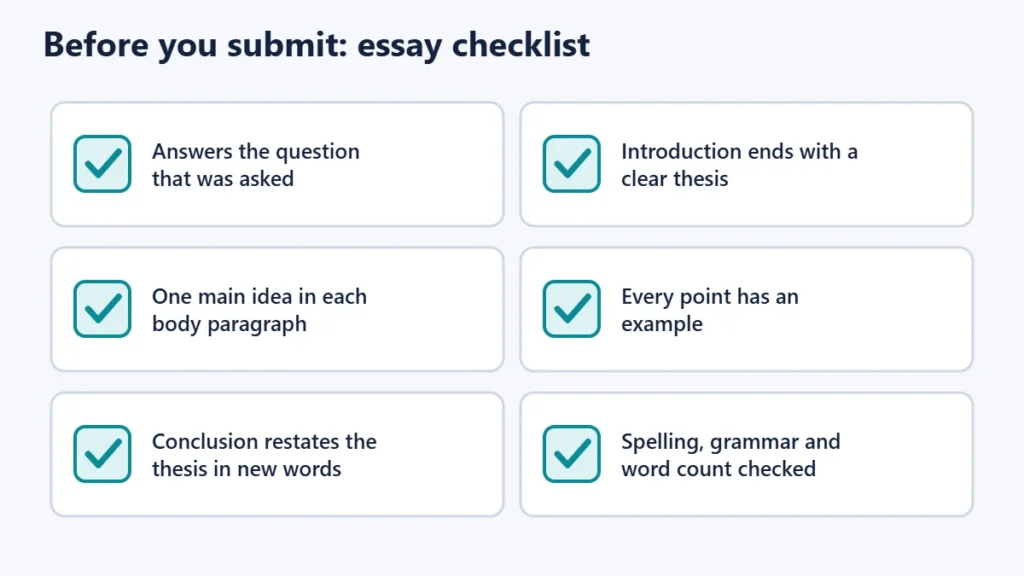
- I have answered the question that was asked.
- My introduction ends with a clear thesis statement.
- Each body paragraph has one main point with an example.
- I have used transition words to connect ideas.
- My conclusion restates the thesis in new words and adds a final thought.
- I have checked spelling, grammar and the word count.
Frequently asked questions
How many paragraphs should an essay have?
A short school essay often has five: an introduction, three body paragraphs and a conclusion. Longer essays have more body paragraphs. What matters most is that each paragraph has one clear purpose and that you follow the word limit you are given.
How long should an essay introduction be?
For most school essays, three to five sentences is enough: a hook, a little background and your thesis. In a 400-word essay, the introduction is usually around 40 to 60 words.
Where does the thesis statement go?
It usually comes at the end of the introduction, so the reader knows your main point before the body paragraphs begin.
Can I use “I” in an essay?
It depends on the type. Narrative and personal essays often use “I”. Formal expository or argumentative essays usually avoid it. If you are unsure, follow your teacher’s instructions.
How can I write an essay on any topic in an exam?
Use the same steps every time: underline the task word, spend a few minutes listing ideas, pick three main points, write a one-sentence thesis, and follow the introduction, body and conclusion structure. Practising with different topics before the exam makes this much faster.
How do I make my essay more interesting?
Start with a strong hook, use specific examples instead of general statements, vary your sentence length, and end with a thoughtful final line. Real examples from history, science, or everyday life make points easier to remember.
Conclusion
Writing a good essay is a skill you can learn, not a talent you either have or lack. Understand the question, plan before you write, state your thesis clearly, build each body paragraph around one point with an example, and finish with a conclusion that ties it all together. Then edit. Practise these steps with a new topic each week, and essay writing will become faster and more natural.