
The SQ3R reading method is a five-step way to study a textbook chapter: Survey, Question, Read, Recite and Review. You skim the chapter first, turn its headings into questions, read to answer them, say or write the answers from memory, and then go over everything again. It turns passive reading into active studying, so you understand and remember more of what you read.
This guide explains each step, shows a worked example from a school geography chapter, gives a printable-style template, and covers when SQ3R works best and the mistakes to avoid.
Key takeaways
- SQ3R stands for Survey, Question, Read, Recite, Review.
- It was developed by educational psychologist Francis P. Robinson and described in his book Effective Study.
- Turning headings into questions gives your reading a purpose.
- The Recite step is a form of active recall, one of the most effective study techniques.
- It works best for textbooks with headings, not for novels.
The five steps of SQ3R
| Step | What you do | Time for a 10-page chapter (approx.) |
|---|---|---|
| Survey | Skim the title, introduction, headings, pictures, bold words and summary | 5 minutes |
| Question | Turn each heading into a question | 5 minutes |
| Read | Read one section at a time to answer its question | 30 to 45 minutes |
| Recite | Close the book after each section and answer from memory | 10 to 15 minutes |
| Review | Go over all questions and answers, then again on later days | 10 minutes, then short repeats |
The time estimates are a rough guide for a typical school chapter; adjust them to the length and difficulty of your text.
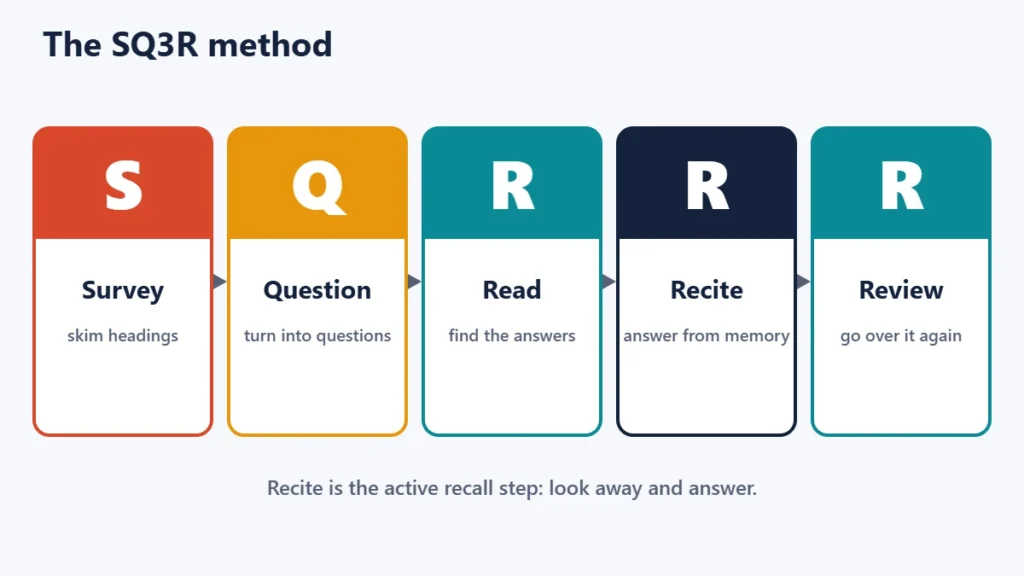
1. Survey
Before reading in detail, get the big picture. Look at the chapter title, the introduction, every heading and subheading, pictures, diagrams, tables, words in bold, and any summary or questions at the end. In a few minutes you will know what the chapter covers and how it is organised.
2. Question
Turn each heading into a question. “Types of Soil” becomes “What are the types of soil, and how are they different?” You can also use the end-of-chapter questions. Write the questions down. They give your reading a purpose: you are now looking for answers, not just reading words.
3. Read
Read one section at a time, actively looking for the answer to that section’s question. Pay attention to bold terms, examples and diagrams. Slow down for difficult parts, and reread a paragraph if it does not make sense.
4. Recite
After each section, look away from the book and answer its question in your own words, out loud or in writing. If you cannot, read the section again. This step matters most, because pulling information out of your memory strengthens it far more than rereading. Our guide to active recall and spaced repetition explains why.
5. Review
When you finish the chapter, go through all your questions again and answer them without looking. Then review again over the next few days. A schedule like the 2357 method tells you when.
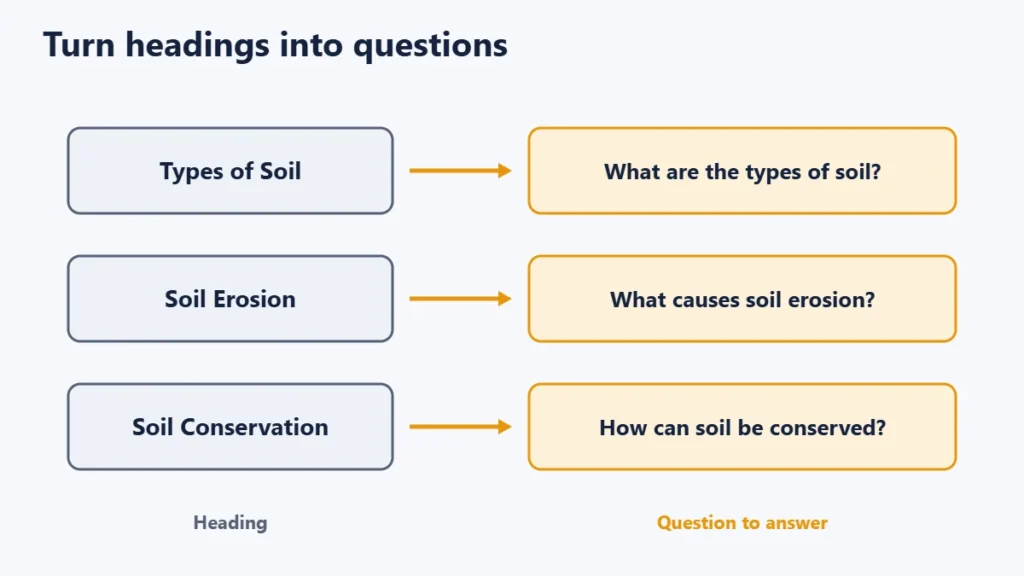
Worked example: a geography chapter on soil
Here is how a Class 10 student might use SQ3R on a section about soils. This is an illustrative example written by The Study Cafe team.
- Survey: the chapter has headings on soil formation, types of soil, soil erosion and soil conservation, plus a map and a table of soil types.
- Question: “How is soil formed?”, “What are the main types of soil?”, “What causes soil erosion?”, “How can soil be conserved?”
- Read: the student reads the “Soil erosion” section looking for causes, and notes deforestation, overgrazing, running water and wind.
- Recite: without looking, the student says: “Soil erosion is the removal of the top layer of soil. It is caused by things like cutting down trees, overgrazing by animals, and running water and wind.” Then checks the book and adds a missing example.
- Review: the next day, the student answers all four questions from memory and marks the one they found hardest for another review.
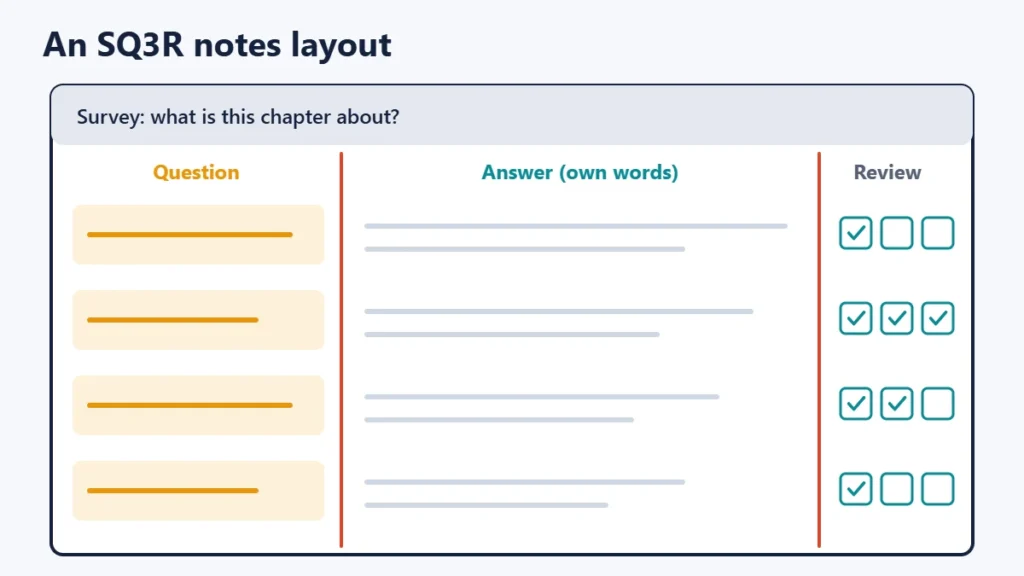
SQ3R template
Chapter: ______________________   Date: ________

SURVEY - what is this chapter about?
_________________________________________

QUESTIONS (from headings)     ANSWERS (after reading)
1. ________________________   _______________________
2. ________________________   _______________________
3. ________________________   _______________________
4. ________________________   _______________________

RECITE: answered from memory?   [ ] 1  [ ] 2  [ ] 3  [ ] 4
REVIEW: day 1 [ ]   day 3 [ ]   day 7 [ ]
This layout is similar to the cue column in the Cornell note-taking method, which also uses questions to test yourself later.
When SQ3R works best, and when it does not
| Works well for | Less suited to |
|---|---|
| Textbooks with clear headings | Novels and stories without headings |
| Science, geography, history, economics | Quick reading for pleasure |
| Long or difficult chapters | Very short texts you can read in a minute |
| Preparing for tests on content | Maths problem practice (use worked examples and questions instead) |
For a story or novel, you can adapt the idea: ask questions about characters and events before each chapter, then recall what happened afterwards.
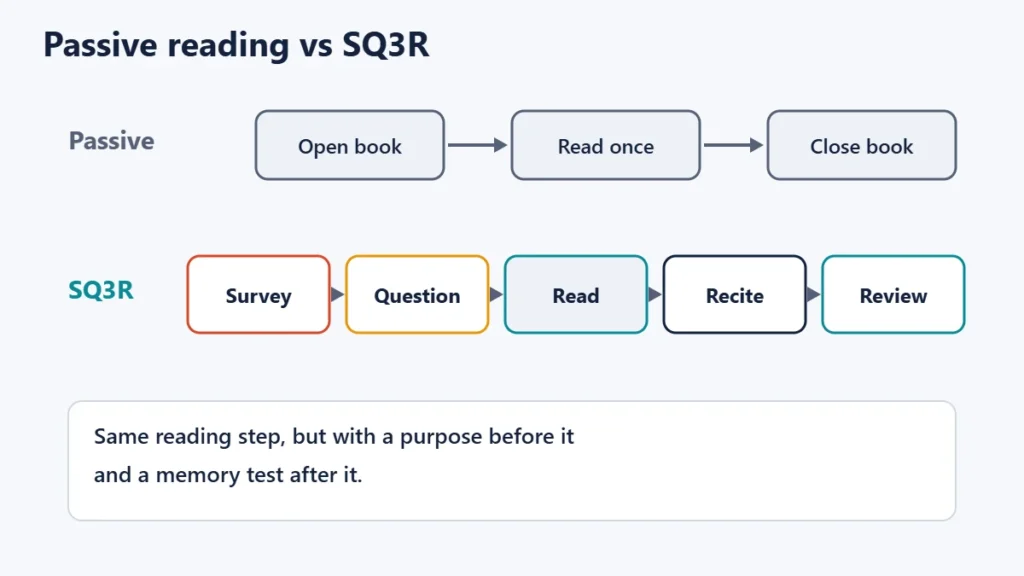
Common mistakes
- Skipping the survey. Diving straight into the first paragraph means you do not know where the chapter is going.
- Writing questions but not answering them. The questions only help if you use them in the recite and review steps.
- Reciting with the book open. Look away. Answering from memory is the point.
- Copying the textbook as answers. Write short answers in your own words.
- Reviewing only once. Come back to the questions over several days.
- Using it for everything. For maths, practise problems; for quick reading, SQ3R is more than you need.
Frequently asked questions
What does SQ3R stand for?
Survey, Question, Read, Recite and Review.
Who created the SQ3R method?
It was developed by Francis P. Robinson, an educational psychologist, who described it in his book Effective Study.
Is SQ3R the same as active reading?
SQ3R is one structured way of reading actively. Active reading means engaging with a text by asking questions, making connections and checking your understanding, instead of just letting your eyes move over the words.
How long does SQ3R take?
It takes a little longer than a single read-through, but much less time than reading a chapter several times. For a typical school chapter, an hour or so is common, plus short reviews later.
Can I use SQ3R with my class notes?
Yes. Survey your notes, turn the main points into questions, reread a section, recite the answers from memory and review regularly.
What is SQ4R?
Some versions add a fourth R, such as “Reflect” or “wRite”, to encourage connecting ideas or writing short notes. The core idea is the same.
Final word
SQ3R turns reading a chapter into a short, active study session: survey to see the big picture, ask questions from the headings, read to answer them, recite from memory, and review over the next few days. Try it on your next textbook chapter, and pair it with short notes for revision to keep what you learn ready for exams.