The interleaving study method means mixing different topics or types of problems in one study session, instead of practising one type until you finish it and then moving on. For example, rather than doing 20 fraction questions followed by 20 percentage questions, you shuffle them together so each question could be either type. It feels harder, but research shows it often leads to better results on tests.
This guide explains how interleaving works, why it helps, a clear example for maths and other subjects, how to build an interleaved revision session, and when it is not the right choice.
Key takeaways
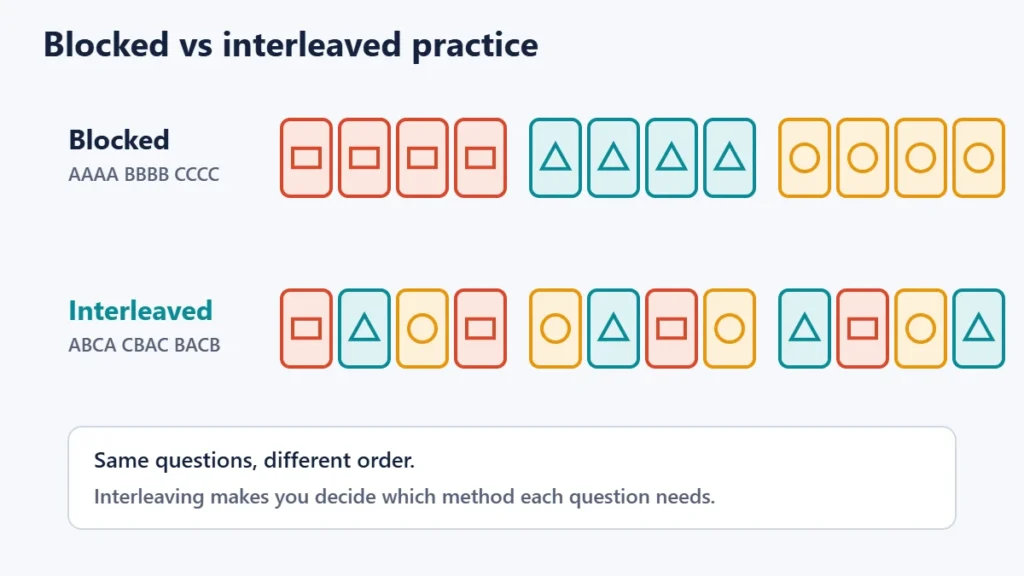
- Blocked practice: AAA BBB CCC. Interleaved practice: ABC BCA CAB.
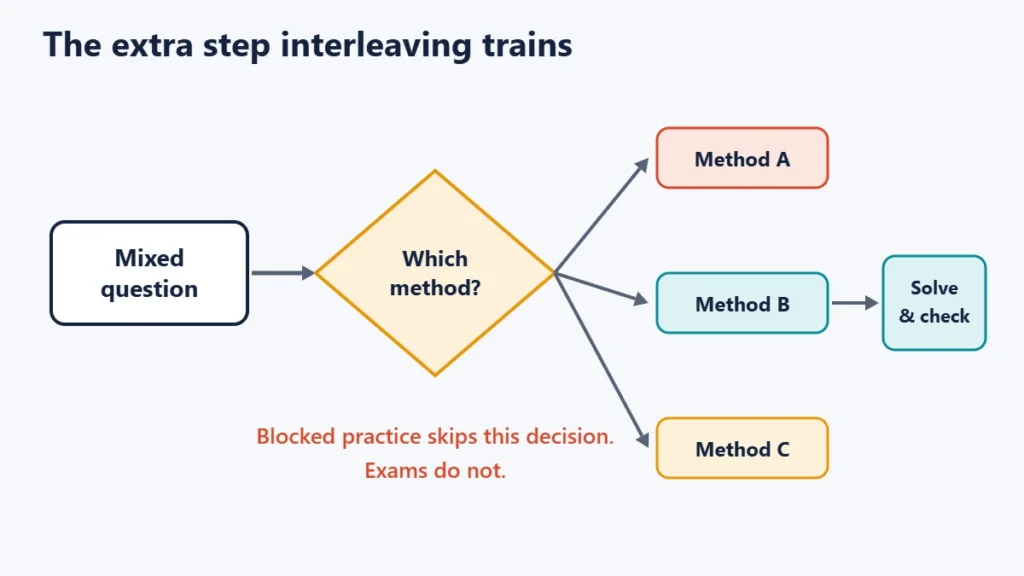
- Interleaving trains you to recognise which method or idea a question needs, which is exactly what exams test.
- It works best for related topics that are easy to confuse, such as similar maths problem types.
- Learn each topic first, then interleave when you practise and revise.
- It feels slower and harder than blocked practice. That difficulty is part of why it works.
Blocked practice vs interleaved practice
Most textbooks and worksheets use blocked practice: a lesson on one topic, followed by a set of questions all on that topic. Interleaving rearranges the same questions.
| Blocked practice | Interleaved practice | |
|---|---|---|
| Order | AAAA BBBB CCCC | ABCA CBAC BACB |
| How it feels | Smooth, quick, confident | Slower, more effortful |
| What you practise | Using a method you already know is needed | Choosing the right method, then using it |
| Performance during practice | Usually higher | Usually lower at first |
| Performance on a later test | Often lower | Often higher |
What does the research say?
Interleaving has been studied most in maths. In a 2007 experiment published in Instructional Science, Doug Rohrer and Kelli Taylor had college students practise finding the volumes of different shapes. Students whose practice problems were shuffled performed worse during practice, but far better on a test one week later, than students who practised each shape in a block.
Later classroom studies by Rohrer and colleagues with seventh-grade maths students found the same pattern in real schools, including a large trial across dozens of classes, where students scored higher on a delayed test after interleaved practice.
Interleaving also helps outside maths. In a 2008 study, Nate Kornell and Robert Bjork asked people to learn the painting styles of different artists. Seeing paintings by different artists mixed together helped people identify the artists of new paintings better than seeing each artist’s paintings in a block, even though most participants believed blocking had worked better.
A 2013 review of study techniques led by John Dunlosky rated interleaved practice as “moderate utility”: promising, especially for maths and problem-solving, but with less evidence across subjects than spaced repetition or self-testing.
Why does interleaving work?
- It teaches you to choose a method. In a block of identical problems, you know the method before you read the question. In an exam, questions are mixed, so you must first decide what kind of problem it is. Interleaving practises that decision.
- It highlights differences. Seeing similar ideas side by side, such as area versus perimeter, or mitosis versus meiosis, makes the differences clearer.
- It adds spacing. When topics are mixed, each one comes back after a short gap, which builds in some spaced repetition.
- It is a “desirable difficulty”. Psychologist Robert Bjork uses this term for practice that feels harder but improves long-term learning.
Worked example: interleaving maths practice
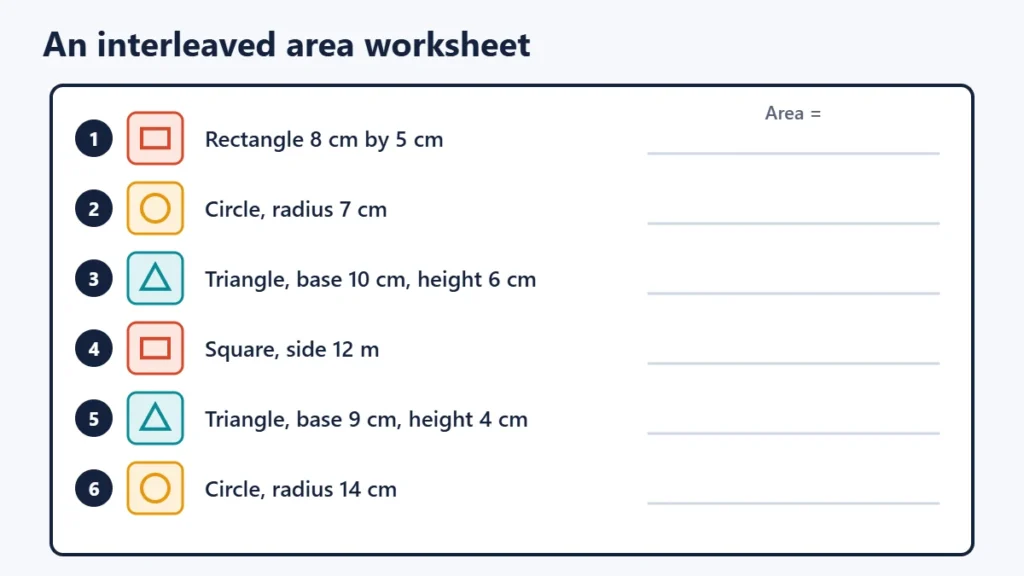
Suppose a Class 8 student has learned three topics: area of a rectangle, area of a triangle and area of a circle. Here is an illustrative practice set written by The Study Cafe team.
Blocked version: questions 1 to 5 are all rectangles, 6 to 10 all triangles, 11 to 15 all circles.
Interleaved version:
- A rectangle is 8 cm long and 5 cm wide. Find its area.
- A circle has a radius of 7 cm. Find its area (use π ≈ 22/7).
- A triangle has a base of 10 cm and a height of 6 cm. Find its area.
- A square garden has sides of 12 m. Find its area.
- A triangle has a base of 9 cm and a height of 4 cm. Find its area.
- A circular plate has a radius of 14 cm. Find its area.
Answers: (1) 40 cm²; (2) 154 cm²; (3) 30 cm²; (4) 144 m²; (5) 18 cm²; (6) 616 cm².
In the interleaved version, the student must read each question, identify the shape and pick the right formula before calculating. That extra step is what exams demand.
Interleaving in other subjects
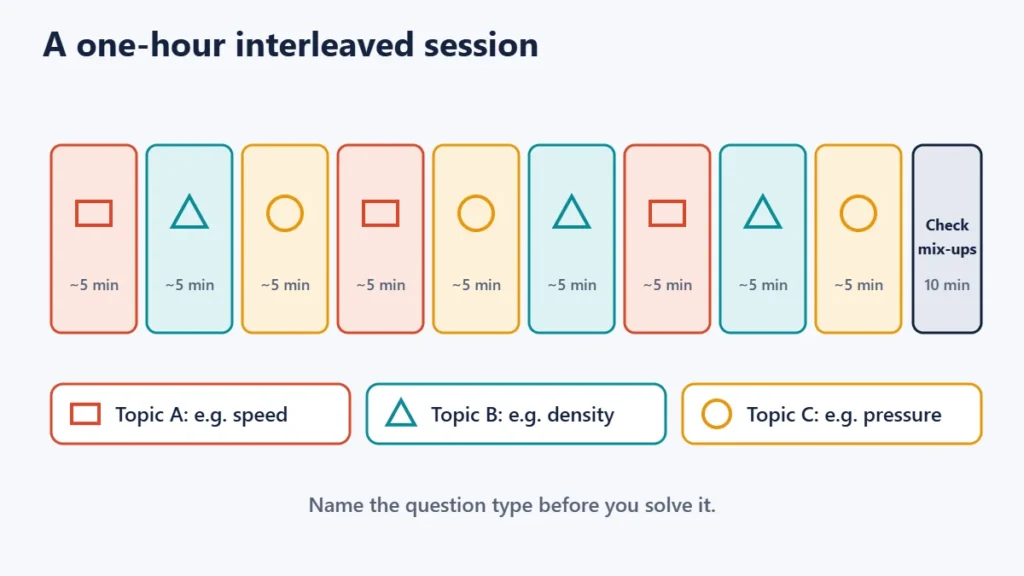
- Physics and chemistry: mix numerical questions from different chapters, such as speed, density and pressure, so you practise picking the right formula.
- Biology: alternate between similar processes, such as photosynthesis and respiration, and write down how they differ.
- History: mix questions on causes, events and consequences from different periods instead of revising one period at a time.
- English grammar: mix sentences that need different tenses or different types of punctuation in one exercise.
- Languages: combine vocabulary from several topics in one flashcard session.
How to build an interleaved revision session
- Learn each topic first. Interleaving is for practice and revision, not for your very first lesson on a topic.
- Pick two to four related topics that you have already studied and that are easy to confuse.
- Collect practice questions for each, from your textbook, past papers or end-of-chapter exercises.
- Shuffle them. Number the questions, mix them up, or simply alternate between sources. Avoid long runs of the same type.
- Before solving each one, name the type. Write “triangle area” or “density” next to the question. This makes the choice explicit.
- Check and note mix-ups. If you used the wrong method, write down how you could have told the difference.
You can combine interleaving with other techniques. Use the 2357 method to decide when to revise, and mix older topics into each review. Testing yourself from memory, as in the blurting method, is another form of the active recall explained in our guide to active recall and spaced repetition.
When interleaving is not the best choice
- Brand-new topics. When you are learning something for the first time, a short block of practice can help you understand the basic method before you start mixing.
- Completely unrelated subjects. Switching between, say, maths and history every five minutes adds little, because there is nothing to confuse. The benefit comes from mixing topics that look similar.
- Very difficult material. If you are getting almost every mixed question wrong, step back, review each topic separately, then try mixing again.
Common mistakes
- Giving up because it feels hard. Lower scores during practice are normal. Judge the method by later tests, not by how it feels.
- Switching too often between unrelated tasks. Interleaving is not multitasking. Finish each question before moving to the next.
- Mixing too many topics at once. Two to four related topics per session is enough.
- Skipping the “name the type” step. Identifying the problem type is the skill you are building.
Frequently asked questions
What is interleaving in simple words?
Mixing different types of questions or topics in one practice session instead of doing all of one type first.
Is interleaving better than blocked practice?
For practising related topics that you have already learned, research often finds interleaving leads to better test results later, even though blocked practice feels easier at the time. For very first learning, a short block can help.
Is interleaving the same as multitasking?
No. Multitasking means doing two things at the same moment. Interleaving means doing one question at a time, but varying the type from one question to the next.
How many topics should I interleave?
Start with two or three related topics. As you get comfortable, mix in older topics too.
Does interleaving work for exams like board exams?
Yes. Board exams mix questions from many chapters, so practising mixed sets is good preparation. Past papers are already interleaved, which is one reason they are so useful.
Conclusion
Interleaving asks you to do something slightly uncomfortable: mix your practice so every question makes you think about which method to use. Learn each topic first, then shuffle related questions together, name the type before you solve, and check your mix-ups. It may feel slower today, but it prepares you for the mixed questions you will face in the exam.