
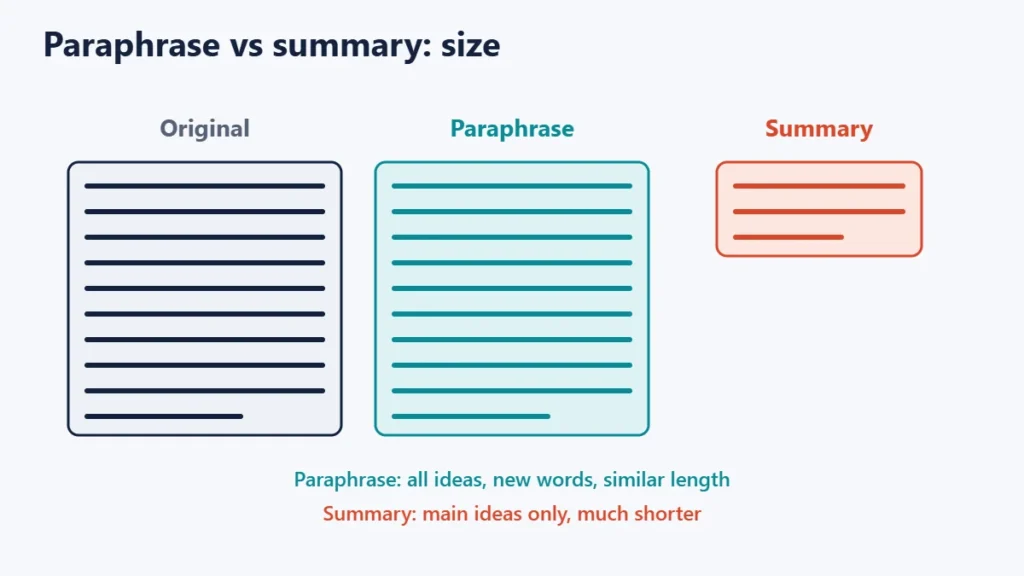
The main difference between a summary and a paraphrase is length and detail. A paraphrase restates a passage in your own words and keeps all of its ideas, so it is about the same length as the original. A summary keeps only the main ideas and leaves out details and examples, so it is much shorter. Both must be in your own words, and both must give credit to the original source when used in an assignment.
This guide compares the two side by side, shows the same passage paraphrased and summarised, explains when to use each, and gives an original practice exercise.
Key takeaways
- Paraphrase = all the ideas, new words, similar length.
- Summary = main ideas only, new words, much shorter.
- A quotation uses the author’s exact words in quotation marks.
- Changing a few words in a sentence is not paraphrasing. You need to rewrite the idea in your own sentence structure.
- In assignments, paraphrases and summaries still need a citation if the idea came from a source.
Summary vs paraphrase: comparison table
| Feature | Paraphrase | Summary |
|---|---|---|
| What it keeps | All the ideas and details | Only the main ideas |
| Length | About the same as the original | Much shorter than the original |
| Usually used for | A sentence or short passage | A paragraph, section, chapter or whole text |
| Words | Your own words and sentence structure | Your own words, condensed |
| Examples and details | Kept | Usually left out |
| Main purpose | Explain a specific idea clearly | Give the big picture quickly |
| Needs a citation in assignments? | Yes, if the idea is from a source | Yes, if the idea is from a source |
Same passage, three ways
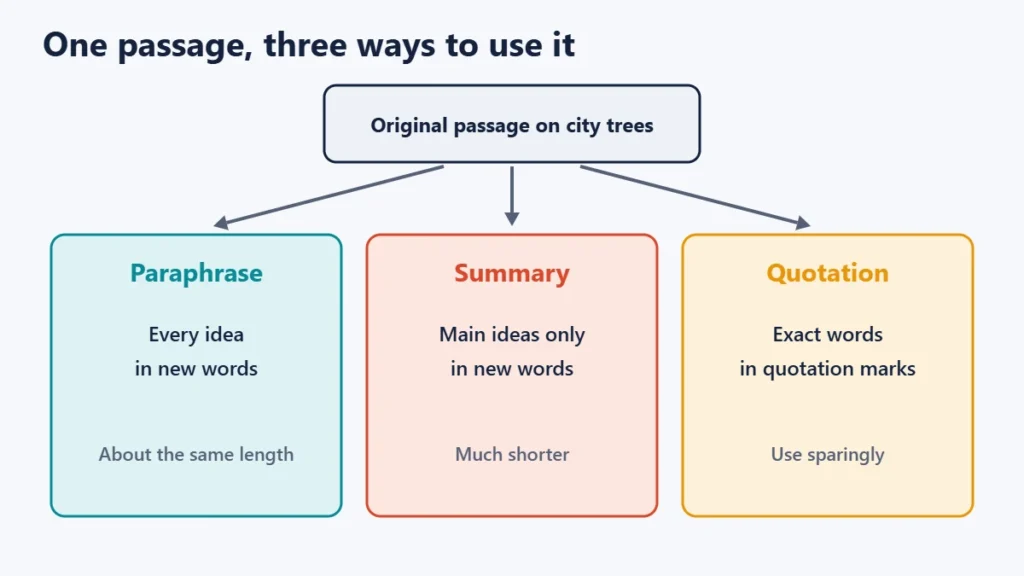
Here is a short original passage written by The Study Cafe team, followed by a paraphrase, a summary and a quotation of it.
Original: “Trees in cities do much more than make streets look pleasant. Their leaves provide shade that can lower the temperature of pavements and buildings on hot days. Their roots help rainwater soak into the ground instead of flooding the roads. They also give birds and insects a place to live in the middle of busy neighbourhoods.”
Paraphrase: Urban trees are useful for more than their appearance. On hot days, the shade from their leaves can cool down roads and buildings. Their roots allow rain to sink into the soil, which reduces flooding on streets. In addition, they offer homes to birds and insects even in crowded parts of a city.
Summary: City trees cool streets, reduce flooding and support wildlife.
Quotation: As the passage puts it, trees “do much more than make streets look pleasant.”
Notice that the paraphrase keeps all four ideas (appearance, shade, rainwater, wildlife) and is about as long as the original. The summary keeps only the three main benefits in one sentence.
How to paraphrase well
- Read the passage until you understand it. You cannot paraphrase what you do not understand.
- Put it away. Cover the original so you are not tempted to copy its wording.
- Write the idea in your own words and sentence structure. Explain it as you would to a friend.
- Compare with the original. Check that you kept every idea and did not change the meaning.
- Fix any copied phrases. If you used a distinctive phrase from the original, either change it or put it in quotation marks.
- Add a citation if this is for an assignment.
How to summarise well
- Read the whole text.
- Find the main idea and the key supporting points.
- Leave out examples, repeated points and minor details.
- Write it briefly in your own words, starting with the main idea.
- Check that nothing important is missing or changed.
For longer texts, our guide on how to write a summary of a chapter gives a full step-by-step method.
When to use each
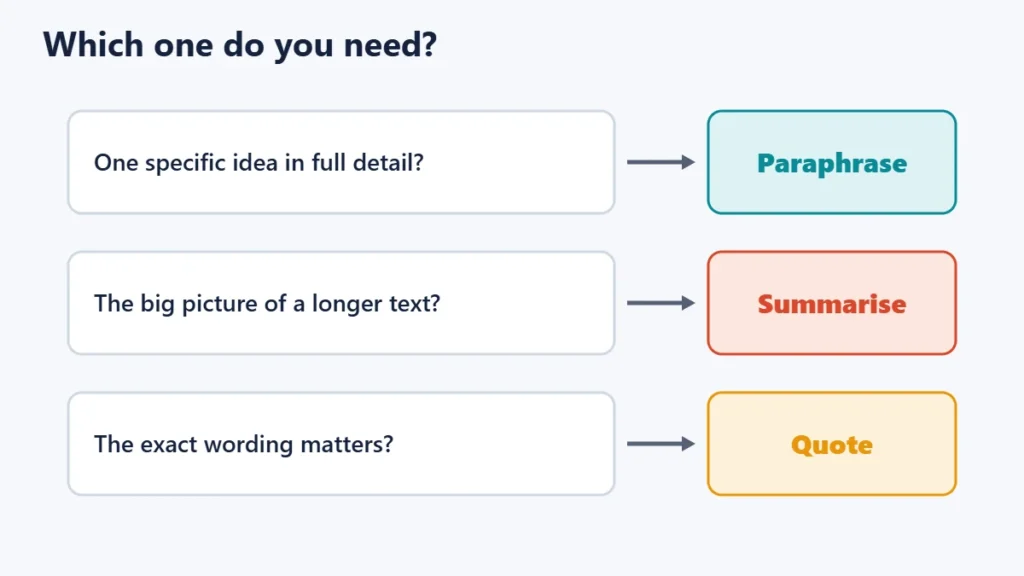
- Paraphrase when you need to explain one specific idea in detail, for example a definition or a key argument in an essay.
- Summarise when you need to give the main points of a longer text, such as a chapter, article or story, in a short space.
- Quote when the exact words matter, for example a famous line, a precise definition or a striking phrase. Use quotations sparingly.
Paraphrasing is not word swapping
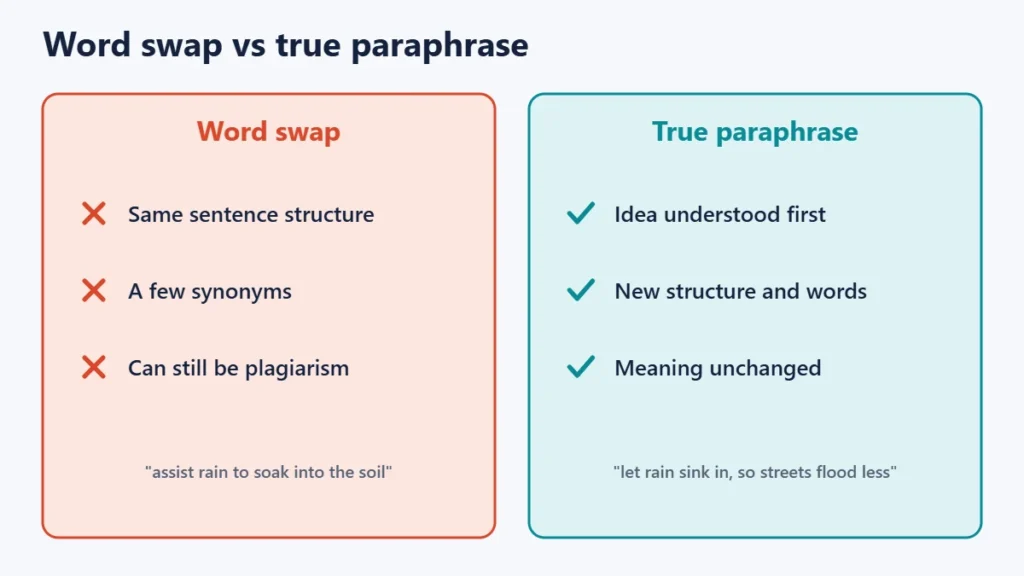
A common mistake is to replace a few words with synonyms while keeping the original sentence structure.
| Version | Example | Acceptable? |
|---|---|---|
| Original | “Their roots help rainwater soak into the ground instead of flooding the roads.” | – |
| Word swap | “Their roots assist rain to soak into the soil instead of flooding the streets.” | No: same structure, only a few words changed |
| True paraphrase | “Because tree roots let rain sink into the soil, streets are less likely to flood.” | Yes: same idea, new structure and wording |
Word swapping can still count as plagiarism, even with a citation, because the sentence is essentially copied.
Practice exercise (original)
Passage: “Reading before bed can help some people relax. A printed book does not give off the bright light of a phone screen, and following a story can take the mind off the day’s worries.”
- Write a paraphrase of the passage.
- Write a one-sentence summary.
Suggested answers: (1) For some people, reading at bedtime is a way to unwind: a paper book lacks the strong glow of a phone, and getting absorbed in a story can distract them from their worries. (2) Reading a printed book before bed can help some people relax.
Frequently asked questions
Is a summary shorter than a paraphrase?
Yes. A summary is much shorter because it keeps only the main ideas. A paraphrase is about the same length as the original.
Do I need to cite a paraphrase?
In academic writing, yes. If the idea came from someone else, you should credit the source even when you use your own words. Follow your teacher’s or school’s citation rules.
Can a paraphrase be longer than the original?
Sometimes slightly, especially if you explain a difficult term. It should not add new ideas.
Is summarising the same as paraphrasing?
No. Both use your own words, but a summary condenses the text to its main points while a paraphrase restates all of it.
Which is better in an essay?
Neither is better; they do different jobs. Use a paraphrase for a detailed point, a summary for an overview, and a quotation when the exact words matter. See our guide on how to write an essay for how these fit into body paragraphs.
Final word
Remember the simple rule: a paraphrase keeps everything and changes the words; a summary keeps only the main points and makes it short. Both need your own words and your own sentence structure, and both should credit the source in assignments. Practise with short passages, and the difference will soon become second nature.