The blurting method is a study technique where you read a topic, close your book, and write down everything you can remember on a blank page as quickly as you can. Then you open your notes, compare, and add what you missed in a different colour. The gaps you find show you exactly what to study next.
Blurting is a simple form of active recall, one of the most effective ways to revise. This guide gives you the step-by-step method, a worked example, tips for different subjects, how it compares with other techniques, and the mistakes that make it less useful.
Key takeaways
- Blurting means writing everything you remember about a topic from memory, then checking it against your notes.
- It works because pulling information out of memory strengthens it more than rereading does.
- Use a second colour for corrections, so you can see your weak spots at a glance.
- It suits fact-heavy subjects best. For maths and problem-solving, pair it with practice questions.
- Repeat it a few days later on the same topic to make the memory stick.
How to do the blurting method: step by step
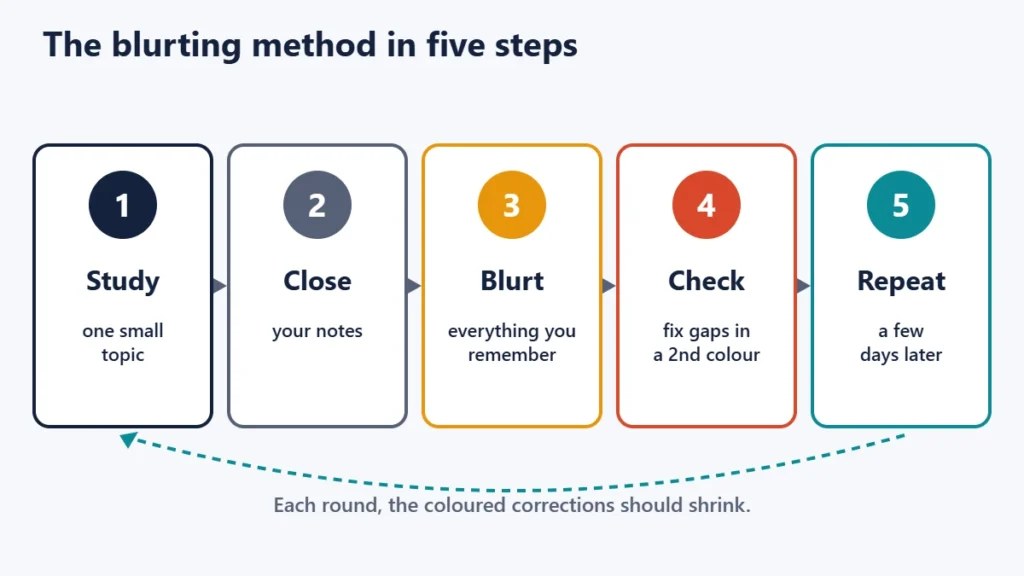
- Pick one small topic. One sub-topic or one textbook section is ideal, for example “causes of the First World War” or “parts of a flower”, not a whole chapter.
- Study it once, properly. Read the section or your notes carefully, paying attention to key terms, facts and how ideas link.
- Close everything. Put your book and notes away.
- Blurt. On a blank page, write down everything you remember: keywords, definitions, dates, diagrams, examples and connections. Do not worry about neatness or order. Keep going until you run out, usually 5 to 10 minutes.
- Check and correct. Open your notes. Using a different coloured pen, add anything you missed and fix anything you got wrong.
- Study the gaps. The coloured parts are your to-do list. Spend a few minutes going over them.
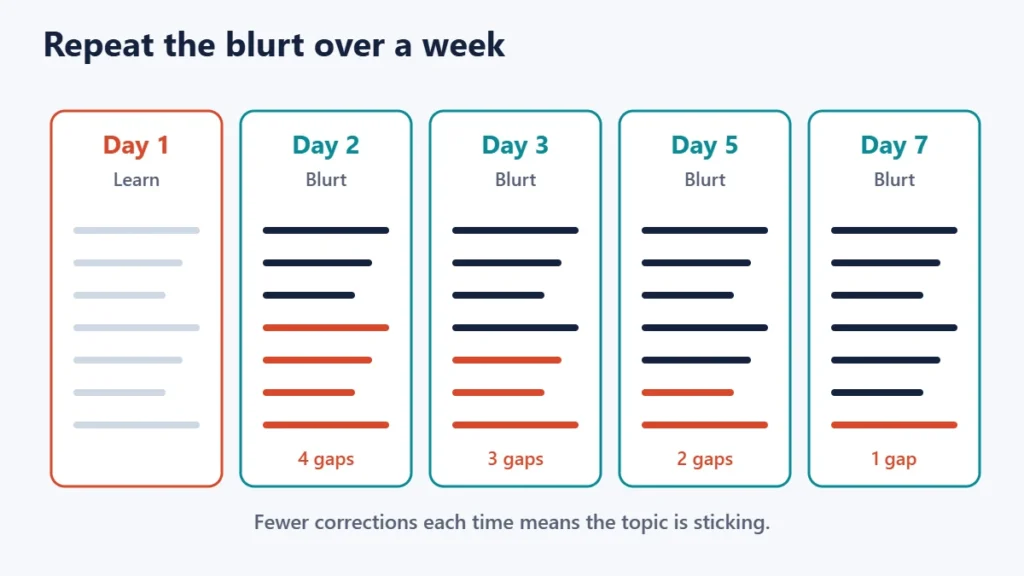
- Blurt again later. Repeat the blurt on the same topic a day or two later, and again after a few more days. You should see less colour each time.
Why the blurting method works
Psychologists call the main idea behind blurting the testing effect or retrieval practice. In a well-known 2006 experiment, Henry Roediger and Jeffrey Karpicke found that students who practised recalling a passage remembered more of it a week later than students who spent the same time rereading it, even though rereading looked better on a test taken just minutes later. A large 2013 review of study techniques led by John Dunlosky rated practice testing as one of only two “high utility” techniques.
Blurting adds two useful features on top of this:
- Free recall. You recall without any prompts, which is harder than answering a flashcard. That extra effort can make the memory stronger.
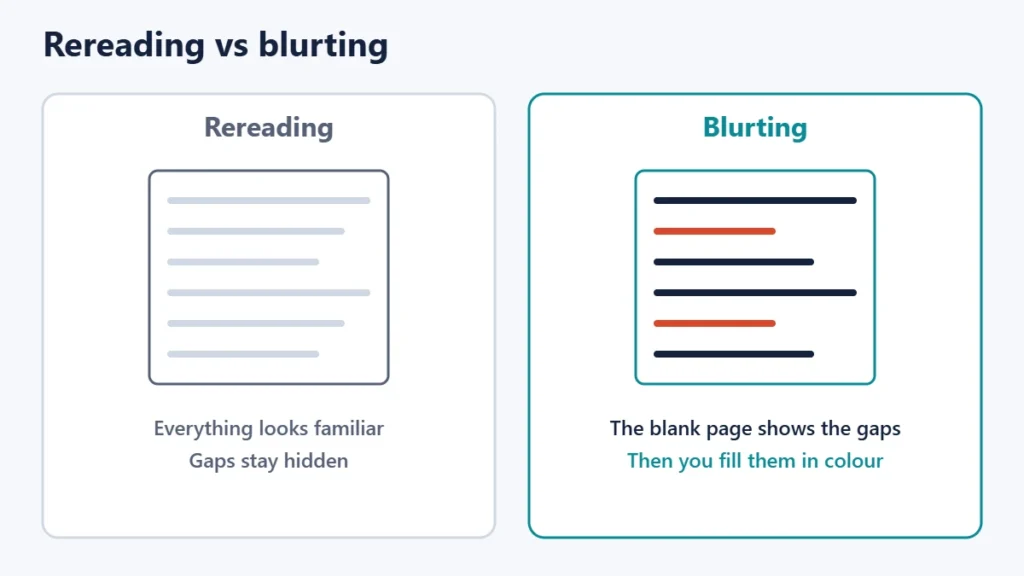
- An honest map of your gaps. Rereading makes everything look familiar. A blank page shows you exactly what you do not know yet.
Studies on blurting itself as a named technique are limited; the evidence is for retrieval practice in general. For the full research picture, see our guide to active recall and spaced repetition.
Worked example: a history topic
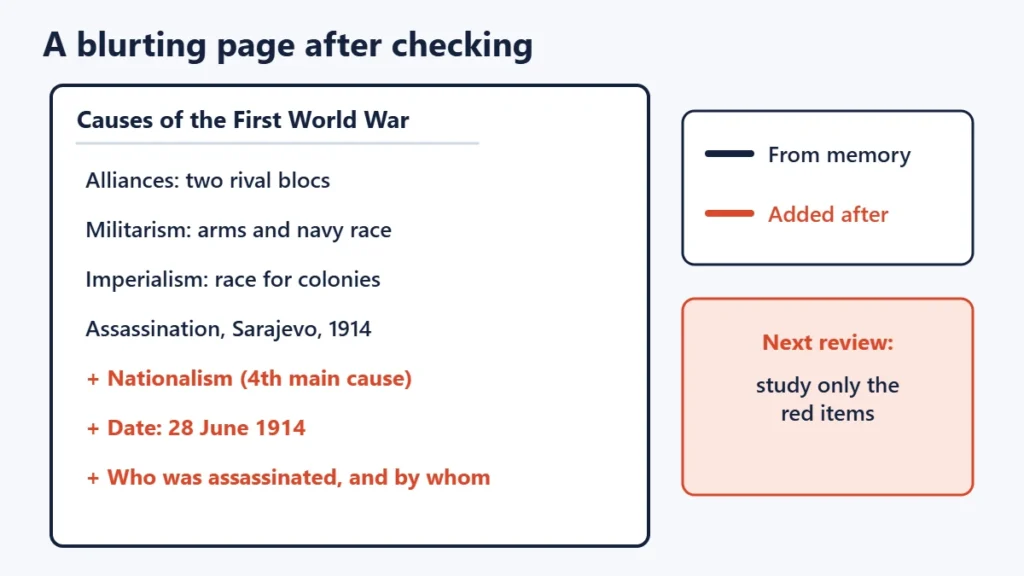
Here is an illustrative example written by The Study Cafe team. A Class 9 student studies a section on the causes of the First World War, then blurts:
- Alliances: Triple Alliance (Germany, Austria-Hungary, Italy) vs Triple Entente (Britain, France, Russia)
- Militarism: arms race, navy race between Britain and Germany
- Assassination of Archduke Franz Ferdinand in 1914, Sarajevo
- Imperialism: competition for colonies
After opening the textbook, the student adds in red: nationalism as the fourth main cause, the assassin’s name and group, and the date (28 June 1914). Those three red items become the focus of the next review. Two days later the student blurts again and remembers nationalism, but still forgets the exact date, so that goes on a flashcard.
Blurting vs other study techniques
| Technique | What you do | Best for |
|---|---|---|
| Blurting | Write everything you remember on a blank page | Seeing what you know about a whole topic |
| Flashcards | Answer one question at a time from a prompt | Definitions, dates, formulas, vocabulary |
| Practice questions | Answer exam-style questions without notes | Applying knowledge, especially in maths and science |
| Feynman technique | Explain the topic in simple words as if teaching | Checking that you understand, not just remember |
| Rereading | Read your notes again | A first look at new material only |
All except rereading are forms of active recall. Blurting is often the best first check on a topic, because it shows you which details need flashcards and which ideas need more practice.
Using blurting in different subjects
- History, geography and civics: blurt causes, events, dates, key people and consequences. Add a timeline or a map sketch from memory.
- Biology: draw and label diagrams from memory, such as the heart or a plant cell, then check the labels.
- Chemistry and physics: blurt definitions, laws and formulas, then follow up with a few practice problems, because remembering a formula is not the same as using it.
- Maths: blurt the method steps and formulas for a topic, then solve questions without looking. Blurting alone will not build problem-solving skill.
- English literature: blurt themes, characters, key quotations and techniques for a text or poem.
- Languages: blurt vocabulary for a topic or a grammar rule with examples.
How to fit blurting into your revision timetable
Blurting works best when you repeat it on a spaced schedule. A simple plan is to blurt a topic the day after you learn it, then again a couple of days later and again a few days after that. The 2357 method gives you a ready-made set of review days for this. If you take Cornell notes, compare your blurt with the notes area of your pages, then use the cue questions for the next review.
Common mistakes to avoid
- Blurting a whole chapter at once. The page becomes overwhelming. Work in small sections.
- Peeking. Looking at your notes halfway through turns blurting back into copying.
- Skipping the check. The comparison step is where you learn. Without it, you may reinforce mistakes.
- Only blurting what you already know well. Choose topics you find hard, not just the comfortable ones.
- Not repeating it. One blurt helps; several spaced blurts help much more.
- Using it instead of practice questions. For subjects where you need to apply knowledge, blurting is a warm-up, not the whole workout.
Try it now: a 10-minute blurt (original exercise)
Without scrolling up, take a blank page and write down everything you remember from this article about the blurting method: the steps, why it works, which subjects it suits and the common mistakes. Then scroll up and add what you missed in a different colour. That is the whole method in action.
Frequently asked questions
What is the blurting method in simple words?
Study a topic, close your notes, write down everything you remember, then check your notes and fill in what you missed.
Is blurting the same as active recall?
Blurting is one type of active recall. Active recall means any study method where you pull information out of memory, such as flashcards, practice questions or blurting.
How long should a blurting session take?
About 5 to 10 minutes of writing for a small topic, plus a few minutes to check and correct.
Is blurting good for maths?
It helps you remember formulas and method steps, but you still need to practise solving problems. Use blurting as a quick check before a set of practice questions.
How often should I blurt the same topic?
Try a day after learning it, then a few days later, then about a week later. Topics with lots of corrections should come back sooner.
Should I blurt on paper or on a computer?
Either works. Paper makes it easy to draw diagrams and use two colours, but typing is fine if it suits you better.
Conclusion
The blurting method is one of the simplest study techniques you can use: a blank page, two pens and a few minutes. Study a small topic, close your notes, write everything you remember, then check and fill the gaps in a different colour. Repeat it over several days and your corrections will shrink as the topic moves into long-term memory. Try it on your next revision session and see what the blank page tells you.