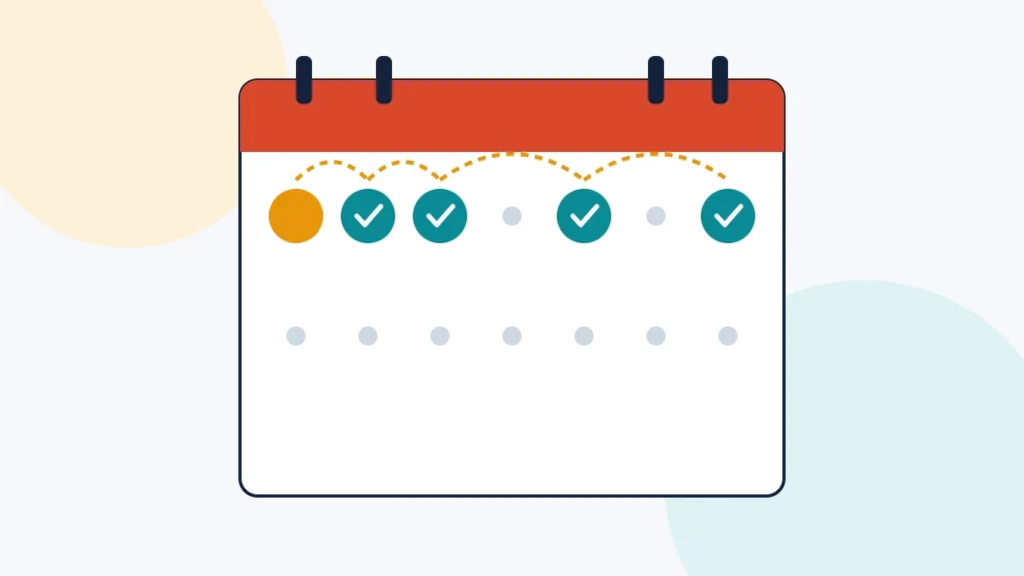
The 2357 method is a simple revision timetable: you learn a topic on day 1, then review it again on day 2, day 3, day 5 and day 7. Each review is short, and the gaps between them get longer, so the topic is revisited just as you start to forget it. It is a ready-made version of spaced repetition that students can follow without an app.
This guide explains exactly how the 2357 method works, how to plan it for several chapters at once, how to run it backwards from an exam date, what to do in each review session, and where its limits are.
Key takeaways
- Day 1: learn the topic. Days 2, 3, 5 and 7: review it.
- Use every review to test yourself, not to reread your notes.
- Start a new topic each day and the reviews overlap into a rolling timetable.
- You can also count backwards from your exam: revise 7, 5, 3 and 2 days before it.
- The exact day numbers are a convenient convention, not a scientific rule. The research supports the idea of spacing, not these specific days.
How the 2357 method works
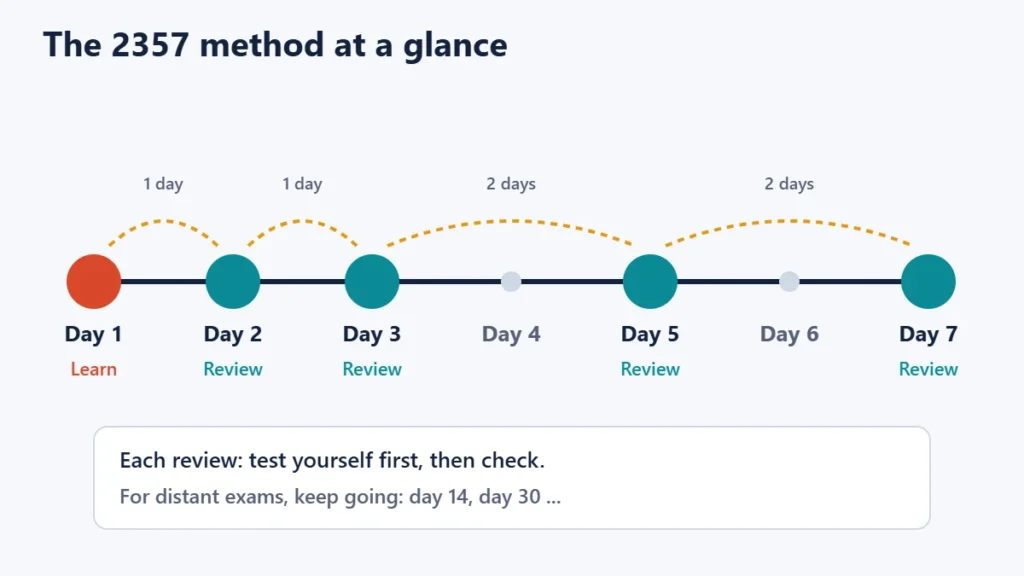
The name comes from the days on which you review. Counting the day you first study the topic as day 1:
| Day | What you do | Typical time |
|---|---|---|
| Day 1 | Learn the topic properly and make questions, flashcards or notes | 45 to 90 minutes |
| Day 2 | First review: test yourself on everything, fix gaps | 15 to 25 minutes |
| Day 3 | Second review: focus on what you got wrong on day 2 | 15 minutes |
| Day 5 | Third review: mixed questions or a short practice set | 15 to 20 minutes |
| Day 7 | Fourth review: full self-test, ideally exam-style questions | 20 to 30 minutes |
The time column is only a suggestion. Short topics need less; big chapters may need more.
Why spacing your revision helps
The 2357 method is built on the spacing effect: information reviewed several times with gaps in between is usually remembered better than the same amount of study crammed into one sitting. Psychologists have studied this effect since Hermann Ebbinghaus’s memory experiments in the 1880s, and a large 2013 review of study techniques by John Dunlosky and colleagues rated spaced practice as one of only two “high utility” techniques for students.
Research also suggests that the best gap between reviews depends on how long you need to remember the material, and that gaps can grow as the exam gets further away. That is why 2357 uses gaps that widen from one day to two days.
It is worth being honest about one point: no study has shown that days 2, 3, 5 and 7 are the perfect numbers. They are a simple, memorable pattern that follows a well-supported principle. If your exam is months away, you should keep reviewing beyond day 7, with longer gaps. Our guide to active recall and spaced repetition explains the research in more detail.
What to do in each review session
The method only works if reviews are active. Rereading your notes four times is not the same as testing yourself four times.
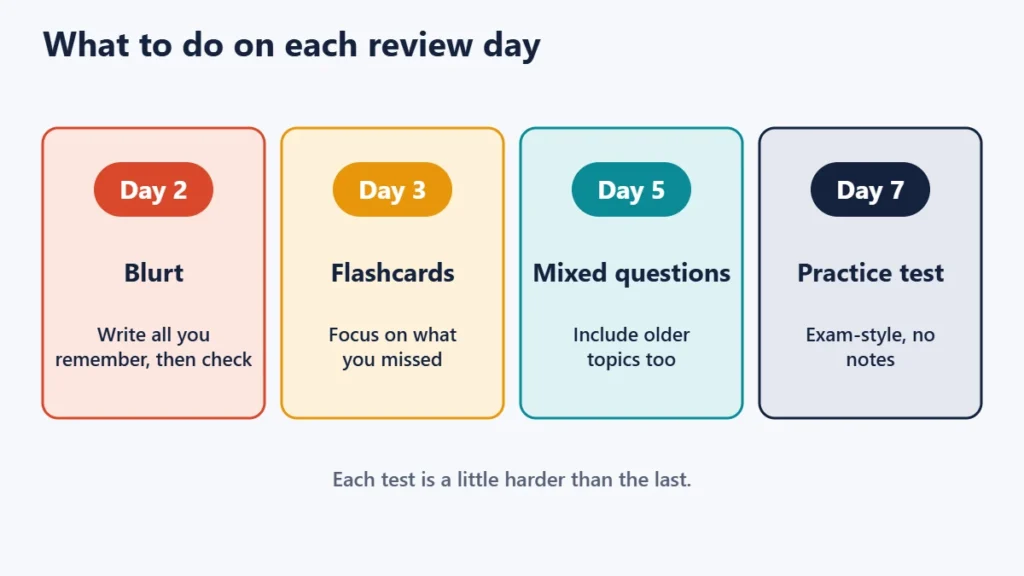
- Day 2: Close your notes and write down everything you remember about the topic, then check and fill the gaps. This is called the blurting method.
- Day 3: Go through your flashcards or cue questions. Spend most of the time on the ones you missed yesterday.
- Day 5: Answer a mix of questions, including some from earlier topics, so you practise choosing the right idea.
- Day 7: Do a short practice paper or the end-of-chapter questions without notes, then mark your work.
If you take Cornell notes, the cue column on each page already gives you ready-made questions for these sessions.
Planning several topics: the rolling timetable
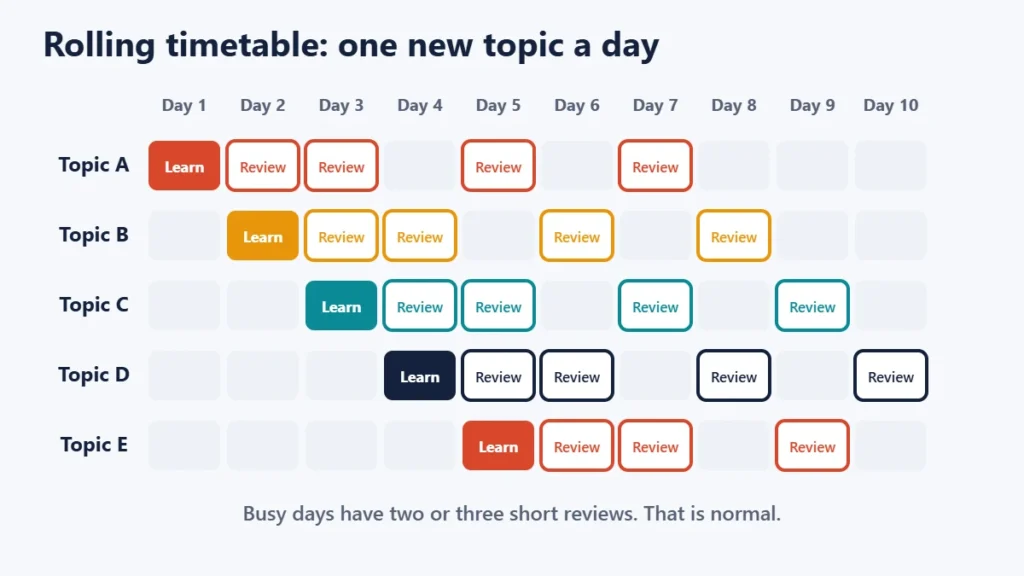
Real revision involves many topics, not one. The trick is to start a new topic each day and let the reviews overlap. Here is a two-week example for one subject, with a new chapter (A, B, C…) started each weekday.
| Day | Learn | Review |
|---|---|---|
| 1 | A | – |
| 2 | B | A |
| 3 | C | A, B |
| 4 | D | B, C |
| 5 | E | A, C, D |
| 6 | – | B, D, E |
| 7 | – | A, C, E |
| 8 | F | B, D |
| 9 | G | C, E, F |
| 10 | H | D, F, G |
Notice that on busy days you may have three short reviews. That is normal and is still much faster than relearning a topic from scratch. On days 6 and 7 in this example, no new chapter is started, which gives a lighter day to catch up.
Running the 2357 method backwards from an exam
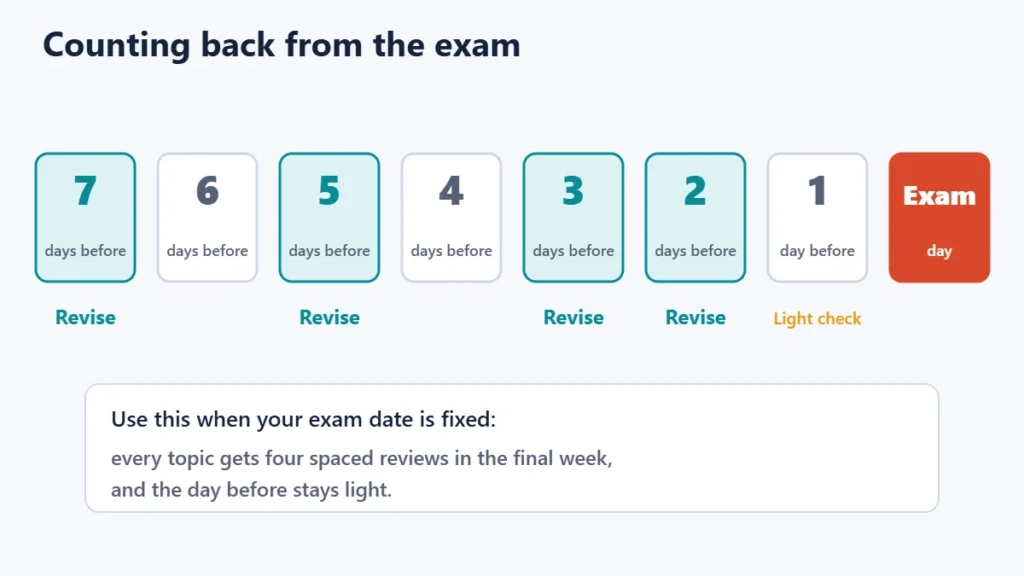
Some students use the same numbers in reverse, counting back from the exam. For a topic you have already learned, you would revise it:
- 7 days before the exam,
- 5 days before,
- 3 days before,
- 2 days before,
leaving the day before the exam for a light final check and rest. This version is handy when the exam date is fixed and you want to make sure every topic gets four spaced reviews in the final week. Many students combine both: the forward version while learning, and the backward version in exam week.
Worked example: Class 10 science, one week
Here is an illustrative plan written by The Study Cafe team for a student revising three chemistry chapters.
- Monday (day 1 for Chapter 1, Chemical Reactions): study the chapter, write 15 question cards.
- Tuesday: learn Chapter 2 (Acids, Bases and Salts). Blurt Chapter 1 for 15 minutes and check.
- Wednesday: learn Chapter 3 (Metals and Non-metals). Review Chapter 1 cards (day 3) and blurt Chapter 2 (day 2).
- Thursday: no new chapter. Review Chapter 2 cards (day 3) and blurt Chapter 3 (day 2).
- Friday: Chapter 1 mixed questions (day 5). Chapter 3 cards (day 3).
- Saturday: Chapter 2 mixed questions (day 5).
- Sunday: Chapter 1 practice questions without notes (day 7). Chapter 3 mixed questions (day 5).
By the end of the week, Chapter 1 has had a full cycle and the others are well on their way, with no session longer than about an hour.
2357 method vs other revision approaches
| Approach | How it works | Main drawback |
|---|---|---|
| Cramming | Study everything just before the exam | Feels productive but fades quickly |
| Rereading notes | Read the same notes several times | Passive; creates a false sense of knowing |
| 2357 method | Fixed review days after learning | Stops at day 7 unless you extend it |
| Flashcard apps with spaced repetition | The app schedules each card individually | Needs cards made in advance and daily use |
| Leitner boxes | Cards move between boxes based on right or wrong answers | Takes a little setup |
Common mistakes
- Rereading instead of testing. The day numbers matter less than what you do on those days. Always try to recall first.
- Stopping after day 7. For exams more than a couple of weeks away, add more reviews with longer gaps, for example day 14 and day 30.
- Starting too many topics at once. One new topic a day is plenty for most students, otherwise the reviews pile up.
- Skipping a review and giving up. If you miss a day, do the review the next day and carry on. The schedule is flexible.
- Not tracking it. Write the review days in a planner or calendar when you first learn a topic, so you do not have to remember them.
Frequently asked questions
What does 2357 stand for?
The numbers are the days on which you review: day 2, day 3, day 5 and day 7, counting the day you first learn the topic as day 1.
Is the 2357 method scientifically proven?
The principle behind it, spaced repetition, is one of the best-supported findings in learning research. The specific days 2, 3, 5 and 7 are a convenient convention rather than a schedule that has been tested against alternatives.
What should I do after day 7?
If the exam is still weeks away, keep going with wider gaps, such as one review at about two weeks and another at about a month. Topics you keep getting wrong should be reviewed more often.
Can I use the 2357 method for board exams?
Yes. It works for any subject and level. For long syllabi, combine the forward version while learning chapters with the backward version in the final week before each paper.
How long should each review take?
Usually 15 to 30 minutes per topic. Reviews should be much shorter than the first learning session, because you are only checking and strengthening what you already know.
What if I miss a review day?
Do it the next day and shift the following reviews slightly. Spacing still works even if the gaps are not exact.
Conclusion
The 2357 method gives you a clear answer to the question “When should I revise this again?” Learn a topic on day 1, then test yourself on days 2, 3, 5 and 7. Start a new topic each day and let the reviews roll on, or count backwards from your exam in the final week. Keep every review active, extend the gaps for distant exams, and you will spend less time relearning and more time remembering.